







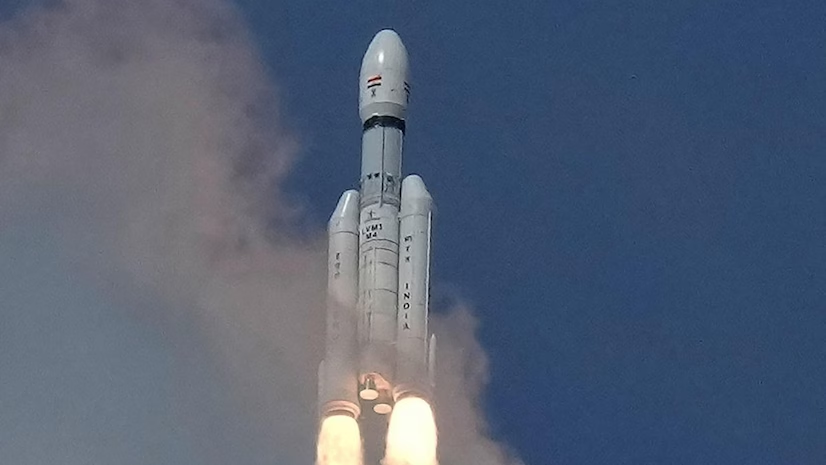


In a moment of national pride and global admiration, the Indian Space Research Organisation (ISRO) has successfully launched its third lunar mission, Chandrayaan-3, marking another significant milestone in India’s rapidly advancing space exploration program. With the primary goal of achieving a soft landing on the Moon’s surface, ISRO aims to cement its position among the elite group of nations capable of conducting complex interplanetary missions.


The mission lifted off from the Satish Dhawan Space Centre in Sriharikota, Andhra Pradesh, aboard the GSLV Mark III-M1 launch vehicle. With millions watching live from across India and around the world, the launch represented the culmination of years of scientific effort, national ambition, and technological progress. Chandrayaan-3 is designed not only to succeed where Chandrayaan-2 narrowly fell short but also to push the frontiers of lunar exploration with indigenous technology and scientific precision.

A Brief Historical Context: Chandrayaan-1 and Chandrayaan-2
India’s journey to the Moon began with Chandrayaan-1 in 2008, which successfully orbited the Moon and made a groundbreaking discovery—the presence of water molecules on the lunar surface. The mission placed ISRO on the global map as a serious contender in planetary exploration and provided critical data that reshaped our understanding of the Moon’s composition.
Building on that success, Chandrayaan-2, launched in 2019, aimed to demonstrate India’s capability to perform a soft landing on the lunar south pole, a region never explored before. Although the orbiter successfully entered lunar orbit and continues to function to this day, the Vikram lander lost communication during the final descent, crashing on the Moon’s surface due to last-minute technical glitches.

Rather than viewing it as a failure, ISRO treated the mission as a learning experience. Chandrayaan-2’s orbiter provided crucial data, and its shortcomings informed the design and execution of Chandrayaan-3, making the new mission more robust, targeted, and technologically refined.
Mission Objectives: A Focus on Precision and Perseverance
The primary objective of Chandrayaan-3 is clear: to achieve a successful soft landing on the Moon. This means gently placing a lander and rover on the lunar surface in one piece, functioning properly, and performing in-situ scientific experiments. The secondary objectives include:
-
Demonstrating end-to-end capability in safe landing and surface mobility.
-
Conducting scientific experiments using the lander and rover.
-
Improving India’s expertise in deep space communication, autonomous navigation, and terrain analysis.
Notably, unlike Chandrayaan-2, Chandrayaan-3 does not include an orbiter, as the Chandrayaan-2 orbiter is still operational and can serve as a communication relay. This design decision allowed ISRO to focus more resources on ensuring the lander and rover systems are as robust as possible.
The Engineering Marvel: Lander and Rover Specifications
The Vikram Lander (Updated Version)
Named after Dr. Vikram Sarabhai, the father of India’s space program, the Vikram lander is designed to execute a controlled descent and achieve a soft landing near the Moon’s south polar region. This area is of significant scientific interest due to its permanent shadow zones and the possible presence of water ice.
Key features of the Vikram lander include:
-
Advanced hazard detection and avoidance systems.
-
Upgraded altimeters and velocimeters for precise navigation.
-
Redesigned landing legs and engine configurations to handle rugged terrain.
-
Capability to perform in-situ experiments, including seismography and thermal conductivity studies.
The Pragyan Rover
Pragyan, meaning “wisdom” in Sanskrit, is a six-wheeled autonomous rover designed to explore the lunar terrain, analyze soil composition, and relay information back to the lander. Weighing around 30 kg, the rover is solar-powered and can travel up to 500 meters during its operational life.
Equipped with:
-
Alpha Particle X-ray Spectrometer (APXS) for determining the elemental composition of lunar soil.
-
Laser-Induced Breakdown Spectroscope (LIBS) for qualitative and quantitative analysis of surface materials.
-
Navigation cameras and hazard avoidance systems to move autonomously.
Launch and Flight Path: Precision in Motion
Chandrayaan-3 was launched using ISRO’s GSLV Mk III, now rebranded as LVM3, India’s most powerful launch vehicle to date. The rocket carried the integrated lander and propulsion module into a highly elliptical Earth parking orbit, from which a series of orbit-raising maneuvers will be conducted to push the spacecraft into trans-lunar injection (TLI).
The propulsion module, unlike a conventional orbiter, will function as a carrier platform and support the lander until separation. It will also perform a secondary scientific mission using the Spectro-polarimetry of Habitable Planet Earth (SHAPE) payload to study Earth from the lunar orbit—an innovative approach to simulate how Earth-like exoplanets may appear.
The expected timeline includes a lunar insertion phase, followed by a period of lunar orbit reduction, separation of the lander, and finally the powered descent and landing, scheduled several weeks after launch. Every step is critical, with real-time telemetry, navigation, and anomaly resolution being essential to success.
Scientific Goals: Unlocking the Secrets of the Moon’s South Pole
The south polar region of the Moon is scientifically fascinating for several reasons:
-
Permanently shadowed craters that may contain water ice—vital for future human missions.
-
Unique geological formations that differ significantly from other lunar regions.
-
An opportunity to study the early history of the Moon and Earth, given the relatively preserved conditions of the lunar south pole.
The data gathered by Pragyan and Vikram will contribute to:
-
Understanding lunar surface evolution.
-
Studying seismic activity and the Moon’s interior.
-
Mapping surface and subsurface thermal properties.
-
Measuring plasma and ionospheric conditions near the surface.
International Reactions and Collaboration
The global response to Chandrayaan-3’s launch has been overwhelmingly positive. Space agencies, including NASA, ESA, and JAXA, have congratulated ISRO, emphasizing the importance of cooperative and peaceful space exploration. In an age of increasing competition, ISRO’s success is viewed as a triumph of human ingenuity, with potential opportunities for international partnerships on future missions.
Additionally, Chandrayaan-3 aligns with India’s larger role in multilateral space research frameworks. India is now participating in discussions around the Artemis Accords and has begun collaborative missions with agencies such as CNES (France) and Roscosmos (Russia).
Public Enthusiasm and National Pride
Across India, Chandrayaan-3 has ignited massive public interest, with students, scientists, and everyday citizens closely following the mission’s progress. Schools and universities are using the launch as an educational moment, encouraging students to pursue careers in STEM (Science, Technology, Engineering, and Mathematics).
Social media has been abuzz with hashtags like #Chandrayaan3, and Prime Minister Narendra Modi has praised ISRO scientists, calling the mission a testament to India’s “Atmanirbhar Bharat” (self-reliant India) vision.
The launch has also inspired comparisons with space agencies with much larger budgets. ISRO, known for its cost-effective missions, has once again demonstrated that high-impact space exploration can be achieved on a modest budget—Chandrayaan-3’s estimated cost is around ₹615 crore (roughly $75 million USD), far lower than comparable missions by other agencies.
Challenges Ahead: A Cautious Optimism
While the successful launch marks a critical milestone, the road ahead is filled with challenges. The final descent phase, dubbed the “15 minutes of terror” in Chandrayaan-2, remains the most complex part of the mission. Precision in deceleration, attitude control, terrain navigation, and landing leg deployment is vital.
ISRO has taken multiple measures to mitigate risks:
-
Redundant sensors and improved fault detection systems.
-
Enhanced ground simulation and failure-mode analysis.
-
Real-time telemetry tracking from the ISRO Telemetry, Tracking, and Command Network (ISTRAC).
With these upgrades, scientists are cautiously optimistic but remain prepared for contingencies. As ISRO Chairman S. Somanath stated, “We are better prepared, wiser, and more confident.”
Looking Ahead: Future Missions and Vision
Chandrayaan-3 is part of a broader vision for India’s role in space. Future plans include:
-
Gaganyaan, India’s first human spaceflight mission.
-
Shukrayaan, a proposed mission to Venus.
-
Participation in Lunar Gateway missions and interplanetary exploration.
-
Expanding ISRO’s commercial space ventures through IN-SPACe and collaboration with private aerospace startups.
In many ways, Chandrayaan-3 is a stepping stone not just for lunar exploration, but for a future Indian footprint on Mars and beyond.
Conclusion: A Giant Leap for India, A Step Forward for Humanity
Chandrayaan-3 represents more than just a space mission—it is a symbol of resilience, learning from failure, and striving for excellence. In successfully launching this third lunar mission, ISRO has once again captured the imagination of millions and reaffirmed India’s place in the constellation of spacefaring nations.
The eyes of the world now turn to the Moon, where the Vikram lander and Pragyan rover are poised to make history. If successful, India will become only the fourth country in the world—after the U.S., the former USSR, and China—to achieve a soft landing on the Moon.
In a world facing immense challenges, ISRO’s pursuit of scientific discovery is a reminder of what humanity can achieve through cooperation, curiosity, and courage.








