







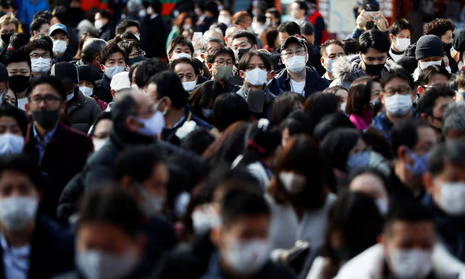

As the world continues to grapple with the evolving dynamics of the COVID-19 pandemic, Japan has declared a state of emergency following a sharp rise in new infections, driven by a potent combination of virus mutations, decreased public compliance with health measures, and the waning effectiveness of early vaccination campaigns. The announcement, made by the Prime Minister in a nationally televised address, marks a significant shift in the country’s strategy to contain what many are calling the most serious wave of COVID-19 infections since the pandemic began.

This renewed state of emergency applies to Tokyo and several major prefectures including Osaka, Kyoto, and Hokkaido. It is accompanied by strict restrictions on movement, business operations, and social gatherings, as authorities struggle to curb the spread of a new, highly transmissible variant that is overwhelming Japan’s healthcare system.
The Trigger: A Surge in New Cases
Over the past month, Japan has experienced a dramatic spike in daily COVID-19 cases, with some days exceeding 80,000 new infections—a level far surpassing previous waves. Health officials attribute this surge to the emergence of a novel subvariant of the Omicron strain, informally known as “Omicron JX”, which shows evidence of higher transmissibility and partial resistance to both vaccine-induced and natural immunity.
Infections have risen most notably among young adults and school-aged children, but hospitalizations are also spiking among elderly and immunocompromised individuals, many of whom received their last vaccine dose more than six months ago. The Japanese Ministry of Health, Labour and Welfare has acknowledged that the current wave is exerting unprecedented pressure on hospitals, with bed occupancy in major cities surpassing 90%.
Declaration of Emergency: Legal and Practical Implications
The decision to declare a state of emergency gives local and national governments enhanced authority to implement and enforce public health measures. Under the current emergency declaration, the following mandates have been instituted:
-
Restaurants and bars must close by 8 p.m., with alcohol sales prohibited after 7 p.m.
-
Large events and gatherings are limited to 5,000 people or 50% venue capacity, whichever is lower.
-
Non-essential businesses are encouraged to reduce operating hours or close temporarily.
-
Remote work is strongly recommended, with companies required to reduce physical office presence by at least 70%.
-
Masks are mandatory in all public spaces, both indoors and outdoors.
Though the government has stopped short of enforcing a full lockdown, citing economic concerns and legal constraints, compliance is expected to be high. Japan’s culture of social responsibility and its relatively cohesive civil society often allow voluntary restrictions to be effective even without coercion.
Public Reaction: Anxiety, Frustration, and Resilience
Public response to the new emergency measures has been mixed. While many citizens recognize the severity of the situation and express support for government action, there is also a growing sense of fatigue and frustration. This is the fifth emergency declaration since the beginning of the pandemic, and some residents are weary of what they perceive as cyclical, ineffective measures.
Small business owners, particularly those in the food and hospitality industries, have voiced concerns about their ability to survive yet another period of reduced revenue. Meanwhile, students, parents, and educators worry about further disruptions to education and mental health.
Nevertheless, a significant portion of the population continues to demonstrate resilience and adaptability. Mask-wearing remains ubiquitous, and public transportation usage has dropped significantly in compliance with government appeals. Many companies have resumed or expanded remote working arrangements, and supermarkets have reported increased demand for home essentials, indicating that residents are preparing for a long haul.
Healthcare System Under Strain
Japan’s healthcare system, long regarded as one of the most efficient in the world, is now facing a critical tipping point. Hospitals in Tokyo, Osaka, and other densely populated areas report being overwhelmed, with ICU beds occupied at near-capacity and a shortage of medical staff becoming increasingly acute.
Dr. Keiko Yamazaki, an ICU physician in Tokyo General Hospital, described the situation as “the most difficult we have faced in the last three years.” According to her, many hospitals have been forced to delay non-COVID procedures and routine treatments, raising concerns about long-term health outcomes for patients with chronic conditions.
Ambulance services are also reporting delays, with some patients having to wait hours before being admitted due to bed shortages. To address these issues, the government has authorized the deployment of military medical teams to assist with hospital staffing, a rare move that underscores the gravity of the crisis.
Vaccination and Booster Campaigns: A Renewed Push
As part of its emergency response, Japan is ramping up efforts to accelerate booster vaccination campaigns. The current focus is on delivering a new bivalent vaccine, which targets both the original SARS-CoV-2 virus and the newer Omicron JX variant. The government has pledged to make this booster available to all adults within the next two months, starting with senior citizens and frontline workers.
However, vaccine hesitancy remains a concern. While initial vaccination rates in Japan were relatively high, booster uptake has slowed significantly. Misinformation and complacency have contributed to a plateau in immunization coverage, particularly among younger age groups.
To combat this, public health officials are launching new awareness campaigns, leveraging influencers, doctors, and community leaders to encourage booster participation. Mobile vaccination clinics are also being deployed in rural and underserved areas, where access to healthcare facilities is more limited.
Economic Ramifications: A Balancing Act
The economic consequences of the new wave and the accompanying restrictions are already being felt. The Nikkei stock index fell sharply following the emergency declaration, and economic analysts are revising their forecasts for Japan’s GDP growth in the upcoming quarters.
Small and medium-sized enterprises (SMEs), which form the backbone of Japan’s economy, are expected to be the hardest hit. The government has announced a new relief package amounting to over ¥2 trillion (approximately $13 billion USD), aimed at providing subsidies to struggling businesses, unemployment assistance, and incentives for teleworking infrastructure.
Tourism, one of the industries most affected by the pandemic, has again come to a halt. Japan had only recently reopened to foreign tourists, and the reintroduction of entry restrictions has dashed the hopes of many in the travel and hospitality sectors.
Despite these challenges, the Bank of Japan has reaffirmed its commitment to maintaining an ultra-loose monetary policy, and the government insists that economic recovery remains a top priority alongside public health.
Global Context: A Familiar Struggle
Japan’s situation reflects a broader global trend as many countries face resurgences of COVID-19 due to new variants, waning immunity, and seasonal factors. Nations like South Korea, the United Kingdom, and Germany have also reported rising cases and are considering renewed restrictions.
What makes Japan’s case notable, however, is its relatively low infection and death rates throughout most of the pandemic, owing to early interventions, cultural adherence to hygiene practices, and strong healthcare infrastructure. The current crisis is a stark reminder that no nation is immune from future waves, especially as the virus continues to evolve.
International observers are watching Japan’s response closely. The World Health Organization (WHO) has praised the country’s transparency and swift policy implementation but has urged greater international cooperation to share data, resources, and strategies for managing the next phases of the pandemic.
The Road Ahead: Hope, Vigilance, and Adaptation
As Japan enters this new and challenging phase of the pandemic, there are signs of hope. Scientists are already working on next-generation vaccines and antiviral treatments, some of which are expected to be approved in the coming months. Innovations in wastewater monitoring, AI-based contact tracing, and early detection technologies offer promising tools for future pandemic management.
The government has also announced plans to develop a permanent infectious disease control agency, aimed at streamlining responses, improving data collection, and coordinating with international health organizations.
For the general public, the path forward will require a delicate balance of caution and perseverance. Many residents are drawing from the country’s history of resilience in times of adversity—from natural disasters to economic upheavals—as they adjust to yet another phase of uncertainty.
Conclusion: A Nation Under Pressure, But Not Without Resolve
The declaration of a state of emergency in Japan amid a new wave of COVID-19 infections underscores the unpredictable and enduring nature of the pandemic. It is a sobering moment that calls for unity, discipline, and innovation.
While the coming weeks will be crucial in determining the trajectory of this outbreak, Japan’s swift response, strong healthcare system, and public cooperation offer reasons for cautious optimism. With decisive action, scientific rigor, and collective resolve, Japan may once again emerge as a global example of how to navigate a public health crisis with dignity and resilience.








