







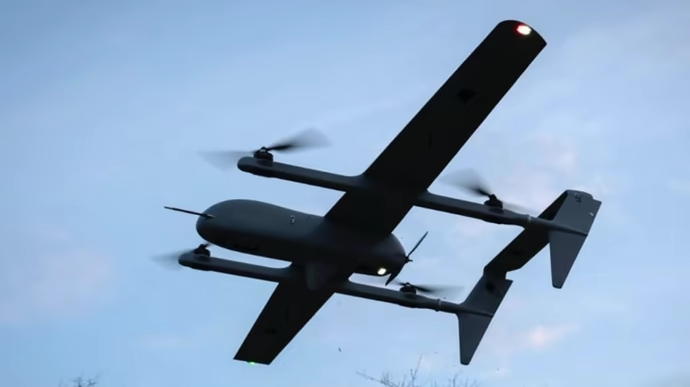
In the early hours of July 1, residents of Saratov and Engels in Russia’s Saratov Oblast reported hearing multiple explosions along with air-raid sirens, signaling another wave of drone-related activity. According to officials, a large-scale drone assault was intercepted, prompting the temporary shutdown of operations at four Russian airports.


I. Widespread Disruption from Drone Threat
1. Airports Halt Operations Amid Security Alert
At approximately 4:00 a.m., Saratov Oblast’s governor, Roman Busargin, confirmed the detection of an incoming unmanned aerial vehicle (UAV) threat, stating that all emergency units were placed on high alert. Reports from Astra, citing local witnesses, indicated loud blasts in Saratov and Engels, and the suspension of flights at Saratov Airport. Similarly, airports in Ulyanovsk, Kazan, and Nizhnekamsk also ceased operations due to the threat.

2. Air Defense Response Across Multiple Regions
Rostov Oblast’s acting governor, Slyusar, announced that air defense forces had successfully intercepted drones over various locations including Rostov-on-Don, Taganrog, and Novoshakhtinsk, as well as in Millerovsky, Myasnikovsky, Aksaysky, Neklinovsky, and Matveyevo-Kurgansky districts. Early assessments suggested no civilian casualties.

II. Drone Incursions Across Russian Territories
1. Defense Ministry Claims High Number of Interceptions
Russia’s Ministry of Defense reported that a total of 60 Ukrainian drones had been neutralized overnight. The drones were intercepted over six Russian oblasts, the temporarily occupied Crimean Peninsula, and over the Black Sea and Sea of Azov.
2. Regional Breakdown of Interceptions
Among the 60 UAVs, 16 were shot down over Rostov Oblast, five in Kursk Oblast, four in Saratov Oblast, two in Belgorod Oblast, and one each over Voronezh and Oryol oblasts. Additionally, 17 drones were brought down over Crimea, 11 over the Sea of Azov, and three over the Black Sea.
III. Strategic Targets and Locations at Risk
1. Engels-2 Military Base
Engels, one of the cities where explosions were heard, is located near the Engels-2 air base—home to Russia’s 22nd Heavy Bomber Aviation Division, which operates strategic bombers like the Tu-95MS and Tu-160. This facility has been previously targeted in drone attacks.
2. Oil and Drone Infrastructure in Tatarstan
In Tatarstan, the city of Nizhnekamsk hosts Taneco, one of Russia’s major oil refineries. The nearby city of Yelabuga is notable for the Alabuga Special Economic Zone, where Russian-manufactured Shahed attack drones are assembled.
3. Deep Strikes Far from Frontlines
The targeted cities—including Engels, Nizhnekamsk, and Yelabuga—are situated over 1,000 kilometers from Ukraine’s border, highlighting the extended range of the UAV operations. These locations have been subjected to repeated drone incursions in recent months, underlining their strategic significance.
Conclusion
The overnight drone activity across several Russian regions, including vital military and industrial hubs, underscores the growing complexity and reach of aerial threats in the ongoing conflict. While Russian authorities claim effective interception of the UAVs and report no civilian harm, the frequency of such attacks on deep-target locations reflects shifting tactics and an escalation in the drone warfare dimension of the conflict.








