








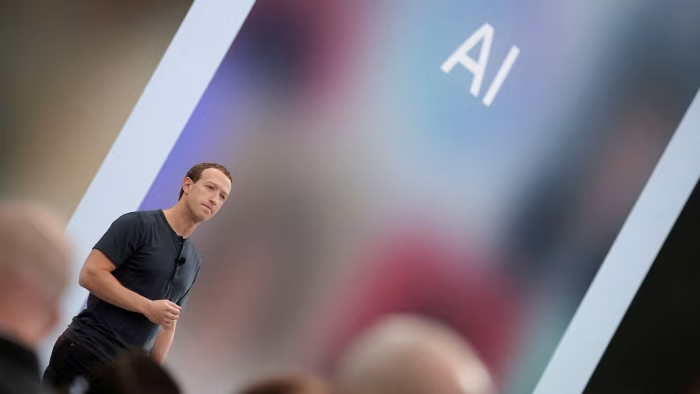
Meta has unveiled a significant restructuring of its artificial intelligence operations by launching Meta Superintelligence Labs (MSL), signaling a bold shift in its long-term vision for AI. Announced by CEO Mark Zuckerberg, the move aims to place Meta at the forefront of the race toward developing highly advanced AI systems, positioning the company in direct competition with OpenAI and Google.

I. A Strategic Reorganization to Dominate the AI Race
1. A Unified AI Vision Under One Roof
The creation of MSL marks a pivotal moment in Meta’s AI journey, as it consolidates the company’s previously scattered AI efforts into a single, cohesive unit. This realignment is designed to streamline innovation and foster rapid development of technologies that align with Meta’s broader goal—delivering AI systems that are both powerful and personally intuitive.
2. Leadership Overhaul Featuring High-Profile Recruits
At the helm of Meta Superintelligence Labs is Alexandr Wang, the former CEO of Scale AI. His appointment follows Meta’s $14.3 billion investment in Scale AI, underscoring the strategic importance of his involvement. Wang now serves as Meta’s Chief AI Officer, bringing deep expertise in AI data infrastructure.
Joining Wang is Nat Friedman, ex-CEO of GitHub and a prominent AI investor, who will co-lead research and product innovation. Their combined leadership is expected to steer Meta toward rapid breakthroughs in AI, leveraging their startup agility within a tech giant’s resources.
II. The Mission: Building a “Personal Superintelligence”
1. Beyond Human-Level Intelligence
In an internal memo, Mark Zuckerberg emphasized that Meta’s next chapter is centered around developing AI that is as capable as humans, yet designed to be more personal and seamlessly integrated into daily life. Unlike current generative AI tools, which often serve general-purpose queries, Meta envisions an intelligent assistant that intuitively understands and supports each individual user.
Zuckerberg described this mission as “the beginning of a new era for humanity,” expressing his determination to lead in delivering “personal superintelligence for everyone.”
2. Reimagining Everyday Interactions with AI
Meta’s goal is to move beyond traditional AI chatbots. The new lab will focus on embedding intelligence directly into Meta’s core platforms—such as WhatsApp, Instagram, and Facebook—transforming them into intelligent ecosystems where AI proactively enhances user experience, from communication to content curation and beyond.
III. Infrastructure Investment and Talent Acquisition
1. Doubling Down on Infrastructure: Chips and Data Centers
To power this next generation of AI, Meta is investing heavily in physical infrastructure. The company is building out custom AI chips, enhancing data center capabilities, and ensuring that it has the computational horsepower to train and deploy increasingly complex models at scale.
This mirrors industry-wide trends where AI dominance is not just determined by algorithms, but also by compute availability, with companies like Meta, Google, and Microsoft aggressively competing in this space.
2. Recruiting Top AI Talent from Competitors
Meta’s recruitment push is equally aggressive. Over the past month, the company has attracted 11 top-tier researchers from industry leaders such as Google DeepMind and Anthropic. Notably, Pei Sun and Joel Pobar—respected names in the AI community—have joined Meta’s new AI division, signaling growing trust in the company’s direction.
This talent influx reflects Meta’s intention to be a major destination for the brightest minds in artificial intelligence.
IV. Context Within the Broader AI Landscape
1. Competing Against Industry Leaders
Meta’s decision to unify and scale its AI operations comes as OpenAI, Google, and Microsoft gain attention with their large language models and rapidly expanding AI ecosystems. Platforms like ChatGPT, Gemini, and Claude have shaped public and enterprise expectations around AI performance, making it critical for Meta to catch up—and ideally, leap ahead.
With its focus on personalization and infrastructure-first strategies, Meta is carving a distinct path in the AI arms race.
2. From AGI to “Superintelligence”
While many companies talk about achieving Artificial General Intelligence (AGI), Meta is reframing the goal as “personal superintelligence.” This semantic shift isn’t just branding—it reflects a commitment to user-centric AI that enhances daily life rather than just replicating human reasoning in the abstract.
By positioning its AI tools as supportive, adaptive, and embedded, Meta hopes to make the concept of superintelligence tangible and relatable to billions of users worldwide.
V. Looking Ahead: What Meta Hopes to Achieve
1. Delivering Breakthrough AI Experiences
The newly formed Meta Superintelligence Labs is expected to roll out new products and updates that integrate AI deeply into user experiences across Meta’s platforms. The vision includes AI that understands context, user preferences, and intent—delivering responses and solutions that feel natural and humanlike.
2. Making AI Ubiquitous and Accessible
Zuckerberg has long championed the idea of AI for everyone—tools that are accessible not just to developers and enterprises, but to individuals navigating everyday life. This democratized approach may become Meta’s core differentiator as other companies continue to build closed or premium-tiered AI platforms.
3. Continued Expansion in Talent and Research
As MSL grows, we can expect further expansion in its research teams, global AI studios, and infrastructure partnerships. With figures like Alexandr Wang and Nat Friedman steering the ship, the lab will likely evolve into a central innovation hub that influences not just Meta’s future—but the trajectory of AI worldwide.
Conclusion
Meta’s establishment of Meta Superintelligence Labs marks a pivotal shift in its AI strategy, transforming scattered initiatives into a unified, aggressive push toward building deeply personal and highly capable AI systems. Through strategic hires, massive infrastructure investments, and a focus on real-world integration, Meta aims to redefine what AI can do—not just for developers, but for everyday users.
By rebranding its ambition as “personal superintelligence,” Meta is not merely chasing the AGI trend—it’s attempting to lead a movement that puts the user first in the next era of digital intelligence. As the AI race continues to evolve, all eyes will be on Meta to see whether this bold bet pays off.