







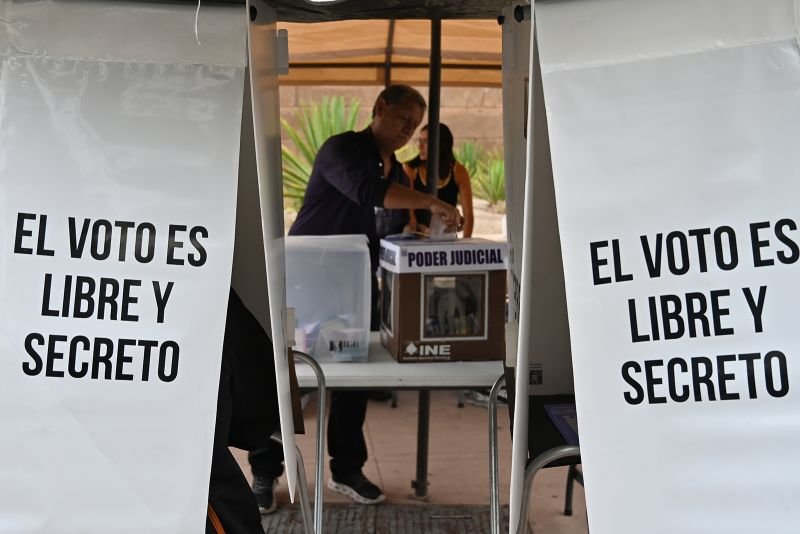


Mexico recently made history by holding its first-ever judicial election, allowing citizens to vote for thousands of judges, magistrates, and even Supreme Court justices. While the government labeled the process a “success,” analysts and observers expressed concerns over the low voter turnout and the potential implications of the reform.


According to the country’s National Electoral Institute (INE), only around 13% of eligible voters participated in the unprecedented vote held on Sunday. While President Claudia Sheinbaum and other officials celebrated the peaceful execution and public involvement in the new electoral system, critics raised serious questions about legitimacy, candidate qualifications, and future risks to judicial independence.

I. The Numbers Behind the Vote
INE officials estimated turnout at between 12.57% and 13.32%, based on nationwide polling samples. This equates to approximately 13 million voters out of 100 million eligible citizens.
President Sheinbaum, at a Monday morning press conference, claimed the election was a “complete success”, citing the nonviolent, low-cost campaign and the freedom of the vote. However, the relatively low participation rate has drawn criticism, especially given the scale and significance of the election.
Voting in Mexico is not mandatory, and the country does not require a minimum turnout to validate election results. Still, analysts argue that low public engagement could impact the credibility of such a groundbreaking reform.
II. Scope and Structure of the Judicial Vote
1. Positions on the Ballot
The election allowed voters to select approximately 2,600 judges and magistrates, including all nine Supreme Court justices—a dramatic shift from the traditional appointment-based system.
This major overhaul of the judiciary stemmed from reforms promoted by Sheinbaum’s predecessor, former President Andrés Manuel López Obrador, who argued that democratizing the judicial system would eliminate corruption, nepotism, and elitism in courtrooms.
2. What Comes Next?
While results are still being counted and are expected to conclude by June 15, the administration is already looking ahead. Sheinbaum mentioned that another judicial vote will be held in 2027, where voters will elect over 1,000 more judicial officials.
“This is a work in progress,” Sheinbaum said. “Everything can be perfected.”
III. Government’s Reaction: Success and Stability
1. Peaceful Process
Interior Minister Rosa Icela Rodríguez praised the peaceful nature of the vote, stating that it occurred in a “climate of peace and tranquility across the length and breadth of the country.” She reinforced the idea that the process met expectations and called it “an innovative exercise” that sparked curiosity and engagement among voters.
2. Controlled Security and Order
Despite widespread skepticism prior to the vote, the election day reportedly went ahead without major disruptions, and the environment remained orderly—an achievement in a nation frequently affected by political unrest and criminal interference during elections.
IV. Critical Concerns from Analysts and Experts
1. Questions Over Legitimacy
While the government celebrates the successful execution of the process, many analysts argue that the low turnout severely weakens its democratic credibility.
Alberto Ramos, Chief Latin America Economist at Goldman Sachs, described the election’s logistics and pre-selection process as “fraught with controversy.” He noted that the large pool of around 3,400 candidates included many with little to no legal experience and questionable qualifications.
This issue was further compounded by the sheer volume of candidates, which made the voting process confusing and cumbersome for many voters.
2. Skepticism Despite Popular Support
Bradesco analyst Rodolfo Ramos expressed surprise at the low participation numbers, especially considering Sheinbaum’s high approval ratings and polling data suggesting widespread support for the idea of electing judges directly. This discrepancy, he suggested, might reflect public disillusionment with the candidate pool, lack of clear information, or a successful boycott effort by the opposition.
V. Controversial Candidates and Electoral Integrity
1. Scandals and Background Checks
The integrity of the candidate list came under fire when it was revealed that several controversial figures had made it onto the ballot. These included a convicted drug trafficker and a former lawyer for notorious drug kingpin Joaquín “El Chapo” Guzmán.
Such revelations ignited public outrage and provided ammunition for critics who argue that opening the judiciary to popular vote could pave the way for organized crime to influence the courts, especially in areas already vulnerable to cartel dominance.
2. Electoral Crime Reports
Adding to the controversy, Mexico’s Specialized Prosecutor’s Office for Electoral Crimes reported receiving 23 complaints of possible electoral violations related to nearly 900 federal-level judicial positions. While investigations are ongoing, these reports have fueled concerns about transparency, fairness, and criminal interference.
VI. Democracy or Danger? The Debate Over Judicial Elections
1. Proponents: Justice by the People
Supporters of the reform, including President Sheinbaum, argue that allowing the public to vote for judges is a powerful step toward greater transparency and accountability in the judicial system. They see this as a necessary correction to a historically elitist and opaque appointment process.
Sheinbaum emphasized that this vote marks the beginning of a larger reform effort, noting that “we will draw conclusions from yesterday to make improvements for 2027.”
2. Opponents: Risk of Politicization and Criminal Influence
Critics, however, warn that electing judges could severely undermine the independence of the judiciary and expose it to corruption or criminal influence. Organized crime groups, they argue, could field their own candidates or manipulate local populations to sway election outcomes in their favor.
Moreover, with thousands of candidates and limited vetting, voters were often forced to choose from unknown individuals—undermining the quality and integrity of judicial appointments.
Conclusion
Mexico’s first judicial election marks a historic turning point in the country’s democratic and legal evolution. The government’s celebration of a peaceful and innovative process is not without merit, especially given the logistical challenges and the scale of reform.
However, the low voter turnout, questionable candidate credentials, and reports of electoral violations cast a long shadow over the legitimacy and effectiveness of the initiative. While the administration sees this as a pathway to democratize justice and dismantle elite privilege in the judiciary, critics caution that it might instead open the door to politicization, corruption, and even organized crime within the court system.
As Mexico prepares for a second round of judicial voting in 2027, the lessons from this first attempt will be critical. Ensuring transparency, voter education, and rigorous candidate vetting must be top priorities if the nation hopes to build a judicial system that is both democratic and resilient.








