







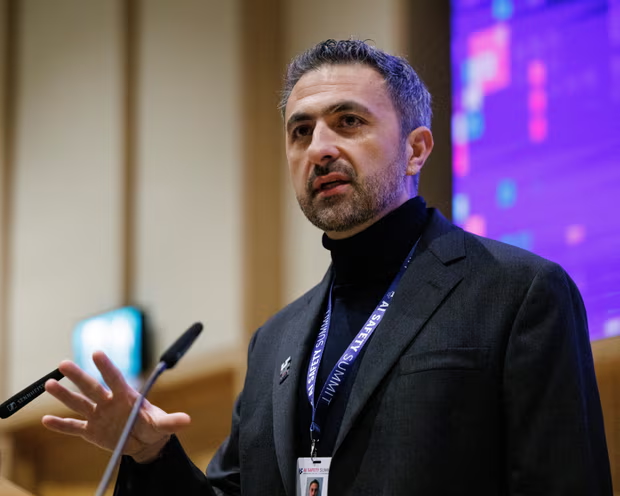


Microsoft has unveiled a groundbreaking artificial intelligence system that’s showing diagnostic capabilities superior to human doctors in challenging medical cases. Spearheaded by Mustafa Suleyman, the tech company’s AI division has introduced a model that replicates how a panel of expert physicians would diagnose complex scenarios. By integrating OpenAI’s advanced o3 model with its new approach, Microsoft’s system was able to solve over 80% of the clinical cases it was presented with—far outperforming human practitioners. This innovation signals a possible future where AI doesn’t just assist in healthcare but fundamentally transforms it.


I. The Rise of Diagnostic AI
1. Outperforming Human Physicians
In diagnostic challenges involving difficult case studies, Microsoft’s AI system displayed an accuracy rate that was significantly higher than practicing doctors. Without access to colleagues or reference materials, physicians successfully diagnosed only two out of ten cases. In contrast, Microsoft’s AI system, aided by OpenAI’s o3 model, correctly resolved over eight of the same ten scenarios. This difference highlights not only AI’s computational advantage but also its ability to process and synthesize complex data sets far more efficiently.

2. A Cost-Effective Alternative
Aside from its accuracy, Microsoft’s system offers a major cost advantage. The AI can streamline the diagnostic process by efficiently determining the necessary tests, cutting both time and expenditure. While Microsoft emphasized the cost-saving benefits, it was careful to note that the aim isn’t to replace doctors but to serve as a powerful tool to enhance clinical decision-making. Human physicians still possess crucial qualities—like empathy and trust-building—that AI cannot replicate.
II. Engineering a Superintelligent Diagnostic System
1. From Test Scores to Real-World Reasoning
Traditional AI assessments, like the U.S. Medical Licensing Examination, often rely on multiple-choice formats that prioritize rote memorization. Microsoft questioned the validity of such tests in measuring deep understanding. Their system, in contrast, follows a real-world clinical reasoning process—asking targeted questions and requesting relevant diagnostic tests before arriving at a conclusion. This mimics how doctors function in practice and moves AI closer to realistic medical problem-solving.

2. Training with Complex Medical Case Studies
Microsoft’s development team trained the AI using over 300 intricate clinical cases sourced from the New England Journal of Medicine (NEJM). These were converted into interactive challenges that the AI system tackled. Instead of relying solely on one large model, Microsoft employed various existing AI technologies—including models from OpenAI, Meta, Google, and others—and connected them through a specialized “diagnostic orchestrator.”
3. The Role of the Diagnostic Orchestrator
The orchestrator is the linchpin of Microsoft’s approach. This agent-like system acts like a virtual team of physicians, determining what tests to run and analyzing the results to form a diagnosis. Its strength lies in integrating multiple expert opinions within a single AI framework. This orchestration enables the AI to access and combine expertise across numerous medical fields simultaneously—something individual doctors, no matter how experienced, cannot match.
III. A Path Toward Medical Superintelligence
1. What is Medical Superintelligence?
Medical superintelligence, as Microsoft describes it, goes beyond artificial general intelligence (AGI). While AGI matches human cognitive ability, superintelligence surpasses it across nearly every domain. In medicine, this means not just accurate diagnoses, but comprehensive understanding, prediction, and intervention—at scale and with near-perfect precision.
2. Transforming the Healthcare Landscape
According to Suleyman, Microsoft’s AI system could be running with near-zero error rates within the next 5 to 10 years. Such capabilities could drastically reduce the burden on global healthcare systems. By empowering patients to handle routine care and equipping doctors with superior diagnostic tools, AI could address both shortages in medical personnel and inefficiencies in current healthcare practices.
3. Limitations and Ethical Considerations
Despite its promise, Microsoft acknowledges the AI system isn’t ready for clinical deployment. More testing is needed, especially on more common and less complex symptoms. Furthermore, the human element in medicine—such as emotional support and ethical judgment—remains irreplaceable. Microsoft maintains that their goal is to assist, not override, the vital human role in healthcare.
Conclusion
Microsoft’s introduction of a medical AI system capable of outperforming doctors in difficult diagnoses marks a significant turning point in the intersection of technology and healthcare. While still under development, the system’s success in replicating and even exceeding human diagnostic reasoning illustrates how AI might reshape medical practice in the coming years. With further refinement, the dream of medical superintelligence may soon be a practical reality—offering support, accuracy, and efficiency on a global scale without replacing the irreplaceable human touch.








