







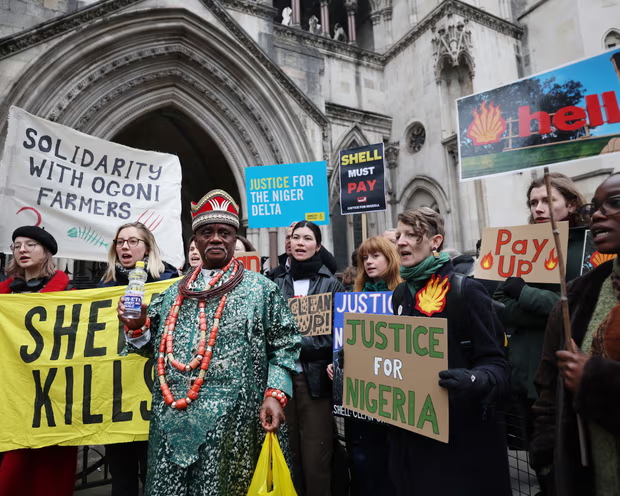
Legal proceedings initiated by residents of two Nigerian communities against Shell are set to go to trial in 2027. The high court in London will hear cases brought by the Bille and Ogale communities from the Niger Delta region, who allege that oil operations by Shell and its Nigerian subsidiary have caused extensive and ongoing pollution, including contamination of drinking water. The legal battle, which began nearly a decade ago, now takes a significant step forward following a ruling by a UK judge addressing several preliminary legal issues.


I. The Longstanding Legal Dispute
1. Background of the Case
The Bille and Ogale communities, with a combined population of approximately 50,000 people, initiated their lawsuit against Shell and its Nigerian-based subsidiary—now known as Renaissance Africa Energy Company—in 2015. They allege that Shell’s oil extraction and pipeline operations in the Niger Delta have led to repeated oil spills, severely damaging their environment and public health.

2. Allegations of Systemic Pollution
Residents claim that oil leaks have not only contaminated land and water but also disrupted daily life and livelihoods. One of the most serious accusations involves the pollution of drinking water sources, which they argue has led to health problems and declining living standards.
II. Court Developments and Legal Findings
1. Preliminary Rulings by the High Court
On Friday, Mrs. Justice May delivered decisions on over 20 preliminary legal matters, following a four-week hearing held in London earlier this year. Her rulings clarified several key aspects of the case and paved the way for a full trial, which is scheduled to begin in March 2027 and expected to last four months.
2. Number of Spills and Continuing Damage
According to Justice May, at least 85 oil spills have been identified in the affected regions. She emphasized that the proceedings are still in their early stages, but noted that Shell could be held responsible even if the spills were caused by third parties such as vandals attempting to siphon oil—a practice commonly referred to as “bunkering.”
3. Ongoing Liability for Pollution
One notable conclusion from the court was that even with a legal limitation period of five years to file a claim, new claims could arise each day the oil remains on contaminated land. This opens the possibility for ongoing liability for pollution that has yet to be addressed or remediated.
III. Community Reaction and Expectations
1. Ogale Leader Calls for Action
King Bebe Okpabi, a leader of the Ogale community, expressed hope that Shell would now approach the matter seriously and seek a resolution. “It has been 10 years since we started this case,” he stated. “We hope that now Shell will stop these shenanigans and sit down with us to sort this out. People in Ogale are dying; Shell needs to bring a remedy. We thank the judicial system of the UK for this judgment.”
2. The Fight for Environmental Justice
Local residents and activists have long called for accountability and a comprehensive clean-up of the affected areas. Many in the communities see this legal process as their best opportunity to secure both compensation and restoration of their environment.
IV. Shell’s Defense and Position
1. Claims of Third-Party Criminal Activity
Shell, while acknowledging the court’s ruling, reiterated that most of the spills in question were caused by criminal activities beyond its control. A company spokesperson stated: “For many years, the vast majority of spills in the Niger Delta have been caused by third parties acting unlawfully, such as oil thieves who drill holes in pipelines or saboteurs.”
2. Argument Against Corporate Liability
The company maintains that it should not be held legally accountable for damages resulting from illegal refining or vandalism. According to the statement, the responsibility for managing these incidents has been handled by a joint venture, previously operated by Shell’s Nigerian subsidiary, which continues to apply its technical expertise in spill response and environmental rehabilitation.
V. Broader Implications of the Case
1. Corporate Accountability in Oil-Rich Regions
This case has wider implications for how multinational corporations operating in oil-rich developing nations are held accountable for environmental harm. It tests the reach of legal systems like that of the UK in addressing grievances originating abroad, especially when corporate activities are tied to public health and ecological degradation.
2. Legal Precedents and Global Attention
The outcome could set a precedent for similar lawsuits against other multinational firms accused of environmental harm in developing countries. Legal experts and environmental advocacy groups are closely monitoring the proceedings, viewing them as a bellwether for global corporate responsibility.
VI. A Decade in Pursuit of Justice
1. Delayed but Ongoing Fight
Although it has taken nearly ten years to reach this stage, the communities of Bille and Ogale remain determined in their quest for justice. The 2027 trial date represents a milestone in what has been a long and often frustrating journey for the claimants.
2. Hope for Future Environmental Reform
Should the court rule in favor of the communities, it could not only lead to monetary compensation and mandated clean-up efforts but also encourage reforms in oil industry practices across the Niger Delta and beyond.
Conclusion
The upcoming high court trial between Shell and the Nigerian communities of Bille and Ogale marks a crucial moment in the long struggle for environmental justice in the Niger Delta. As both sides prepare for a full hearing in 2027, the case serves as a reminder of the deep scars left by decades of oil exploration and the increasing demand for corporate accountability. While Shell argues it is not liable for damages caused by criminal activity, the affected communities are hopeful that the UK’s legal system will deliver a fair judgment that could bring them the compensation and remediation they have sought for nearly a decade.
Tags: Shell, Oil Pollution, Nigeria, Niger Delta, Bille Community, Ogale Community, Environmental Justice, UK High Court, Corporate Accountability, Oil Spills, Human Rights, Africa Litigation, Renaissance Africa Energy








