







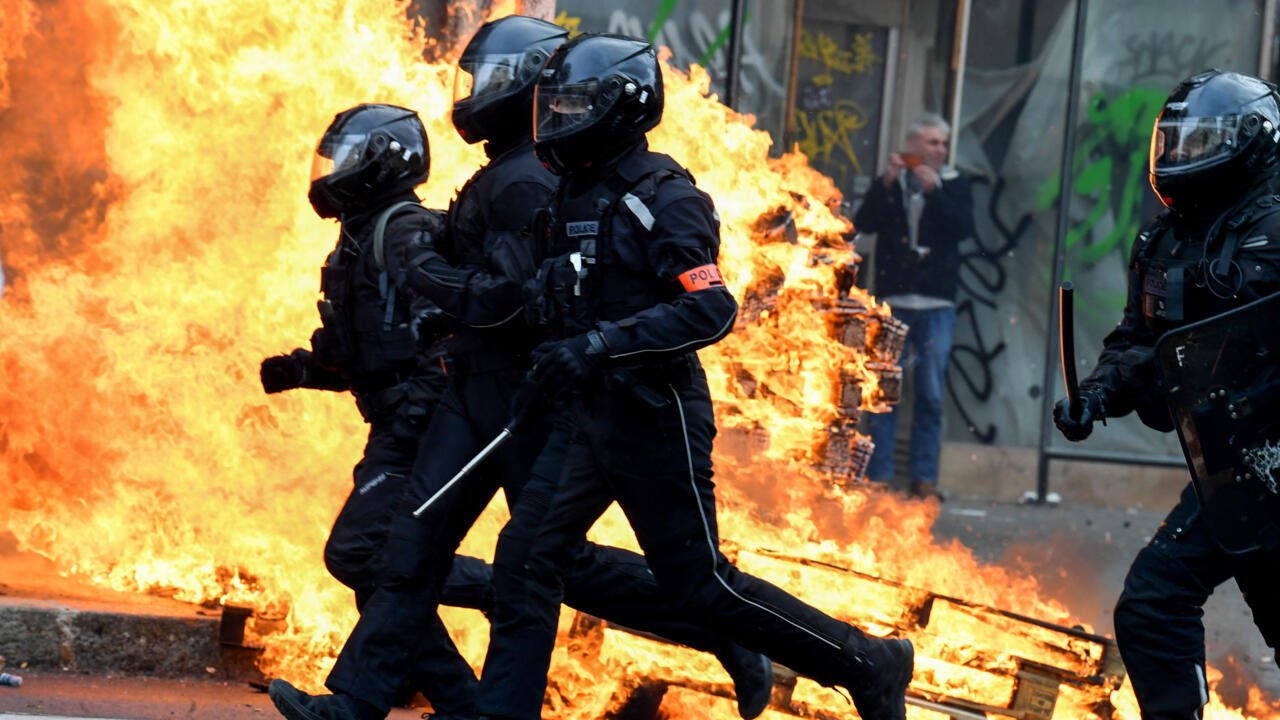

On the evening of May 27, 2025, the streets of Paris erupted into chaos as thousands of demonstrators clashed with police forces over the French government’s controversial pension reform proposal. What began as a peaceful rally quickly spiraled into violent confrontations, with tear gas, water cannons, and rubber bullets deployed by riot police to disperse increasingly agitated crowds.


By midnight, authorities confirmed that over 65 people had been injured, including both protesters and police officers. More than 150 individuals were arrested, and several Parisian neighborhoods were left scarred with damaged storefronts, overturned vehicles, and graffiti-covered public property. The event marks the latest and most violent chapter in a long-brewing public resistance to President Emmanuel Marchand’s pension overhaul.

Background: A Nation on Edge Over Pensions
At the heart of the unrest lies a deeply polarizing plan to raise the national retirement age from 62 to 64 and alter the way pension benefits are calculated. The French government argues that these reforms are necessary to preserve the financial sustainability of the pension system in the face of increasing life expectancy and a shrinking workforce.
However, the plan has ignited widespread opposition from labor unions, students, civil servants, and ordinary citizens who view the reforms as unjust, regressive, and a threat to hard-earned social protections. Critics contend that the government is shifting the burden of financial responsibility onto workers, particularly those in physically demanding jobs who rely on early retirement options.

“For many people in France, retirement is a hard-earned right, not a privilege to be delayed,” said Lucie Bernard, a spokesperson for the CGT, one of the country’s largest trade unions. “The government’s reforms punish the working class while protecting the interests of corporate elites.”
A Day of Rage: How the Clashes Unfolded
The protests began early in the day, with demonstrators gathering at symbolic locations such as the Place de la République and the Bastille. Waving flags, banging pots, and carrying signs that read “64 Is Too Much” and “Hands Off Our Pensions,” the crowds marched through central Paris, echoing chants that demanded the resignation of President Marchand and a complete withdrawal of the reform bill.
While most participants remained peaceful, tensions escalated as night fell. A fringe group of hooded protesters, often associated with the anti-capitalist “black bloc,” began setting fire to trash bins, smashing shop windows, and throwing projectiles at police officers. The authorities responded swiftly, deploying riot squads equipped with shields and batons to cordon off affected areas.
The confrontations intensified near the Gare de Lyon and the Latin Quarter, where skirmishes lasted for several hours. Tear gas clouded the air as protest leaders urged restraint, but by then the crowd had splintered into various factions, some seeking confrontation, others trying to flee.
Injuries and Arrests: A Mounting Toll
Hospitals across Paris reported a surge of injuries related to the clashes. At least 42 protesters sustained wounds from rubber bullets or physical altercations, while 23 police officers were treated for burns, bruises, and head injuries caused by thrown objects.
One particularly alarming incident involved a 22-year-old university student who was hospitalized with a fractured skull after being struck by a police baton. The incident is now under internal investigation, adding to the public outcry over the police’s handling of the protest.
According to the Paris Prefecture of Police, 158 individuals were arrested for vandalism, resisting arrest, and possession of illegal weapons such as improvised explosives and slingshots.
The Government’s Response: Firm Stance Amid Growing Pressure
In a televised address following the protest, President Marchand expressed sympathy for peaceful demonstrators but condemned the violence as “unacceptable.” He reaffirmed the government’s commitment to passing the pension reform legislation, stating: “France must adapt to a changing demographic reality. The future of our pension system depends on our courage today.”
Interior Minister Chloé Duval defended the police’s actions, asserting that they had acted with restraint under difficult circumstances. “Our officers were attacked and provoked by violent extremists,” she said. “We will not allow a small group of radicals to hijack a national debate.”
Despite these reassurances, opposition politicians from both the left and right have called for a parliamentary inquiry into police conduct and the broader societal impact of the reforms.
Unions and Activists: Vowing to Continue the Fight
Far from being cowed, the labor movement has pledged to escalate its resistance. In a joint statement, eight major unions announced a new wave of coordinated nationwide strikes, mass rallies, and blockades of key infrastructure such as ports, train lines, and airports.
“We are not giving up,” declared Jean-Pierre Lemoine, leader of the FO union. “This government is waging war on social justice, and we will respond with solidarity and resistance.”
Student organizations, climate activists, and feminist groups have also joined the coalition, framing the pension reform as part of a broader pattern of social inequality and state repression.
Historical Context: Pension Reform as a Flashpoint
This is not the first time that pension reform has sparked unrest in France. Similar proposals in 1995, 2003, and 2010 led to massive strikes and nationwide demonstrations. What distinguishes the current situation, however, is the convergence of economic anxiety, post-pandemic fatigue, and political disillusionment.
Polls indicate that over 70% of French citizens oppose the current reform plan, and trust in political institutions is at a historic low. Many feel that the government is out of touch with everyday struggles and that democracy itself is under threat.
“The way this reform is being pushed through, without meaningful dialogue, is fundamentally undemocratic,” said Camille Arnaud, a political science professor at Sciences Po. “It reflects a deeper crisis in French governance.”
The International Lens: Europe Watches Closely
The violence in Paris has drawn international attention, with foreign governments urging their citizens to avoid protest hotspots. Media outlets across Europe are drawing parallels to similar pension debates in Germany, Spain, and Italy.
The European Union has so far refrained from official comment, but analysts say the unrest could influence broader continental conversations about aging populations, labor market reforms, and the sustainability of social welfare systems.
“The French model of retirement has long been seen as a gold standard,” said Matthias Engel, a German labor economist. “What happens in Paris today could reverberate across Europe tomorrow.”
The Media’s Role and Public Perception
French media coverage of the protest has varied widely, with some outlets emphasizing the violence and others focusing on the protesters’ demands. State broadcaster France 2 aired live footage of burning cars and looted stores, while independent outlets like Mediapart highlighted stories of injured workers and student activists.
Social media platforms, meanwhile, have been flooded with firsthand videos showing both police aggression and acts of vandalism. Hashtags such as #RetraitesEnColère (Angry Pensions) and #ParisBurning trended globally on X (formerly Twitter).
The Way Forward: Reform or Retreat?
As the dust settles, the central question remains: will the government back down, or press forward? Despite mounting pressure, insiders suggest that the Marchand administration is determined to pass the reform in its current form, possibly through the use of Article 49.3 of the French Constitution, which allows legislation to be adopted without a parliamentary vote.
Such a move would likely inflame tensions further and could trigger a vote of no confidence. Opposition leaders have warned that any attempt to bypass democratic processes will be met with even greater resistance.
“We are standing at a crossroads,” said opposition figurehead Elise Martin of the Green Party. “The choice is between social justice and authoritarianism.”
Conclusion: A Nation in Turmoil, a Future Uncertain
The events of May 27 have laid bare the deep fissures within French society. What began as a policy dispute over pension age has become a symbol of larger anxieties: about economic inequality, democratic legitimacy, and the future of the French social contract.
As Paris cleans up the shattered glass and charred debris, the nation is left grappling with difficult questions. Can reform be achieved through consensus, or is conflict inevitable? Will the government listen to the cries of its people, or tighten its grip?
For now, the only certainty is uncertainty. And in the streets of Paris, the sound of protest still echoes through the air.








