






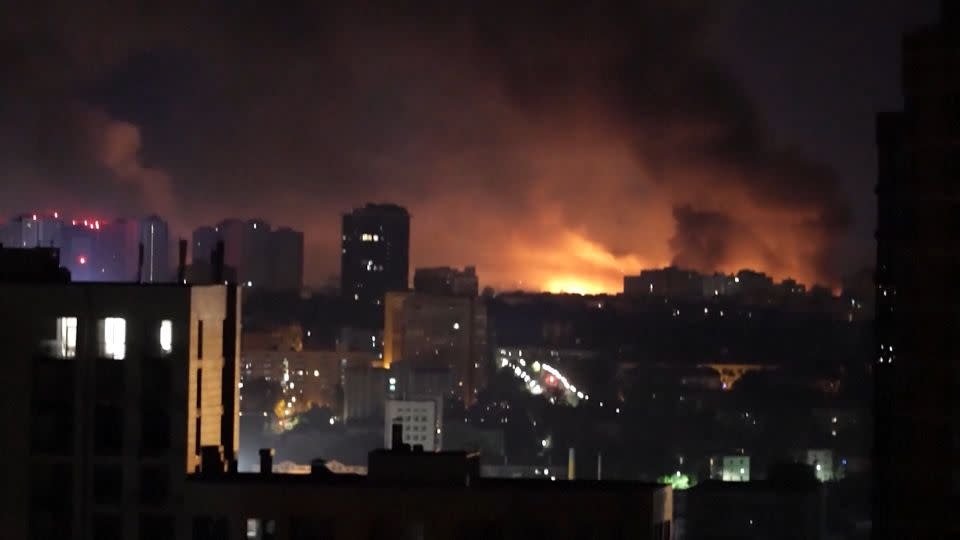
Astringent clouds of smoke and explosions lingered over Kyiv on Friday morning as residents emerged from bomb shelters after enduring a historic Russian drone attack. The barrage hit just hours after U.S. President Donald Trump revealed that his call with Vladimir Putin produced “no progress” toward a ceasefire. Ukrainian officials described the assault as one of the most devastating in three years of conflict.

I. Scale and Impact of the Drone Assault
1. Record-Breaking Raid Deep in Kyiv
The city faced an unprecedented aerial offensive that damaged multiple residential zones and buildings. Kyiv’s emergency services confirmed at least one fatality and 23 injured in the 13‑hour onslaught. Ukrainian air defenses intercepted 476 of 539 drones, and Russia also launched 11 cruise and ballistic missiles. Regional authorities noted that Ukrainian interceptor drones destroyed 60 of the incoming threats.

2. Widespread Shelter Use by Civilians
Thousands of Kyiv residents spent the night underground—in subway stations and parking garages—as drone engines and explosions echoed through the city. Foreign Minister Andrii Sybiha described it as “absolutely horrible and sleepless,” while President Zelensky called it “one of the most large‑scale air attacks” to date.
II. Political and Tactical Context
1. Tension Follows Trump–Putin Call
Zelensky highlighted the timing: “Air raid alerts began almost simultaneously with media coverage of Trump and Putin’s phone call.” He interpreted the attack as evidence that Russia has no intention of ending the conflict.
2. Defense Under Pressure Amid Political Stalemate
Following the attack, Trump admitted the call with Putin yielded no breakthroughs on a ceasefire and expressed his disappointment, stating Putin “is not looking to stop the war.” The Kremlin, responding through spokesman Dmitry Peskov, noted Putin’s insistence on continuing military goals via “political and diplomatic means.”

3. Ukrainian-US Coordination for Air Defense
Trump later spoke with Zelensky, who emphasized the need to strengthen Ukraine’s air defenses. Their teams will meet to explore collaboration on counter-drone systems and related technologies.
III. Humanitarian Fallout and Civilian Response
1. Health Impacts and Environmental Risks
Following the attack, Kyiv recorded “high” air pollution levels. The Environment Ministry advised residents to remain indoors, close ventilation, use air purifiers, and urged those with respiratory or heart conditions to be particularly cautious.
2. Public Outcry Over US Policy
Some Kyiv residents criticized Trump’s perceived inaction. Yuriy told CNN, “This attack confirms Trump is a scoundrel,” citing his halt on aid shipments. Yulia Ryzhkova added that Trump’s passivity emboldens Putin, calling the violence “pure terror” enabled by impunity.
IV. Security Concerns and US Policy Shift
1. Russia’s Drone Fleet Expanding
Ukraine’s Unmanned Systems Forces commander warned that Russian long-range drone attacks could ramp up to 1,000 daily, based on intelligence estimates.
2. U.S. Arms Pause Raises Worries
The U.S. has paused some weapons shipments—including air defense missiles—to preserve domestic stockpiles, according to Trump. This has raised alarm in Ukraine, which relies heavily on U.S. military support—especially since the president’s return to office casts doubt on continued aid.
Conclusion
Friday’s largest drone attack on Kyiv in three years came as diplomatic efforts for a ceasefire faltered. While Ukraine’s defenses performed admirably, the assault heightened anxiety over diminishing U.S. military support and sparked public frustration. With Russia’s drone capabilities intensifying, Ukraine’s reliance on international defense partnerships has never been more critical.