






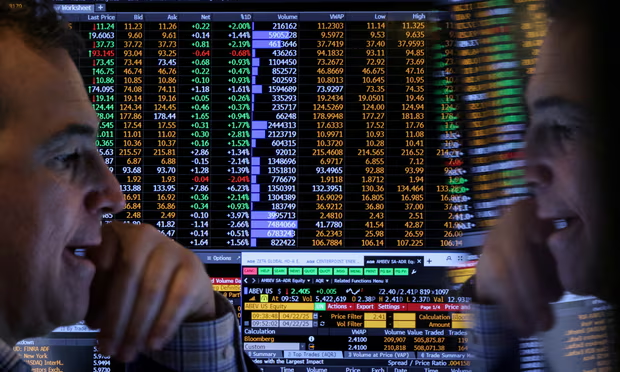

The recent volatility in the U.S. stock market—fueled by escalating trade tensions with China and rumors of potential Federal Reserve leadership changes—has sent ripples through global financial systems. Despite a partial rebound, the market remains lower than at the beginning of the year. While this may seem distant to everyday life in the UK, many Britons may unknowingly have exposure to these fluctuations through their pension investments and other savings. Understanding this connection can help individuals make informed decisions about their financial future, particularly during periods of economic uncertainty.


I. The UK’s Deep Investment in US Markets
1. British Pension Funds Are Tied to US Stocks
A significant number of UK pensions and investment funds are heavily allocated toward American equities. Dr. Sayantan Ghosh Dastidar, a senior lecturer in economics at the University of Derby, explains that by 2023, only 20% of UK investment portfolios were directed toward domestic equities—a record low. In contrast, 35% were invested in U.S. assets. Over the past decade, there has been a marked decline in UK-focused investments, while the portion devoted to American markets has almost doubled.


This trend means that many UK savers, through their pension plans or managed funds, have exposure to the performance of U.S. stocks, whether or not they realize it.

2. Big Tech’s Influence on UK Retirement Plans
Dan Coatsworth, an analyst at AJ Bell, notes that the allure of major U.S. tech companies is a significant driver of this investment strategy. Due to their rapid growth and global influence, firms like Apple, Microsoft, and Nvidia attract substantial attention from fund managers. As a result, it’s likely that a portion of your pension is linked to their performance, making you indirectly affected by swings in the American stock market.
II. Understanding Your Pension Exposure
1. Types of Pension Schemes Affected
Whether you’re part of a defined contribution (DC) or defined benefit (DB) pension scheme, there’s a strong chance your retirement funds include U.S. equities. Defined contribution schemes, where retirement income is based on investment performance, are especially influenced by market behavior.

For instance, about 30% of Aegon’s default DC fund is composed of U.S. equities, surpassing the combined allocation to UK stocks and government bonds. Similarly, Royal London’s RLP governed portfolio includes 22% U.S. equities—again exceeding investments in domestic or European shares. These providers manage retirement savings for a vast number of UK employers.
Even traditional defined benefit schemes, such as the Universities Superannuation Scheme (USS)—the UK’s largest—hold U.S. equities, making their performance relevant to thousands of members.
2. Finding Out Where Your Money Is Invested
If you’re curious about your pension’s exposure to global markets, your provider can supply a fund factsheet detailing the asset breakdown. Helen Morrissey from Hargreaves Lansdown advises individuals to request this information to understand their risk exposure and investment spread.
III. What the Market Drop Means for You
1. Should You Be Concerned About the Losses?
Despite recent downturns, long-term trends remain positive. Coatsworth points out that although the S&P 500 has fallen 10% year-to-date, it has still climbed 89% over the past five years and surged 150% in the last decade. This suggests that long-term investors could still be enjoying significant gains, provided they have maintained exposure to U.S. stocks over time.
As such, financial advisers generally recommend staying calm during downturns. Historical patterns show that markets tend to recover, and overreacting can often result in locking in losses.
2. Impact on Retirement Timelines
Individuals nearing retirement may feel more pressure from recent market movements. Zoe Alexander of the Pensions and Lifetime Savings Association (PLSA) notes that those close to drawing their pensions or considering purchasing an annuity might benefit from waiting. Delaying withdrawals, even temporarily, could allow time for market recovery and potentially safeguard more of your savings.
3. Defined Benefit Members Have a Safety Net
People enrolled in defined benefit schemes have less reason to worry. These plans promise a guaranteed income and place the responsibility for funding that income on the employer. Many of these schemes also maintain large financial surpluses to cushion against market swings. For example, the USS has a £9.7 billion surplus, while the Barclays Bank UK Retirement Fund holds a £1.8 billion buffer.
If you’re still unsure about your pension options, free, government-backed guidance is available from the Money & Pensions Service. Pension Wise, specifically for those over 50, offers tailored advice and support.
IV. Looking for Silver Linings
1. Exchange Rate Opportunities
While the market turmoil may create stress for investors, there are potential upsides for consumers—particularly those planning holidays. A weaker U.S. dollar means your pounds may go further when traveling to the United States.
Sarah Coles from Hargreaves Lansdown advises that some travelers might consider exchanging currency early to take advantage of the favorable rate. However, those heading to Europe may find the opposite. The euro has gained strength as a perceived safe haven, meaning that UK tourists could get less value for their money in eurozone countries.
Coles emphasizes that shopping around for competitive exchange rates is now more important than ever to make the most of your travel budget.
Conclusion
The knock-on effects of U.S. stock market volatility extend far beyond Wall Street. For many UK residents, especially those with pension funds and managed investments, changes in American markets can subtly but significantly impact long-term financial wellbeing. While recent downturns may be unsettling, history suggests that staying the course usually pays off for long-term investors. Those nearing retirement may need to adjust their timelines, but most savers can weather the storm without making drastic changes. And for some, such as holidaymakers or value investors, the current environment may even present timely opportunities.








