






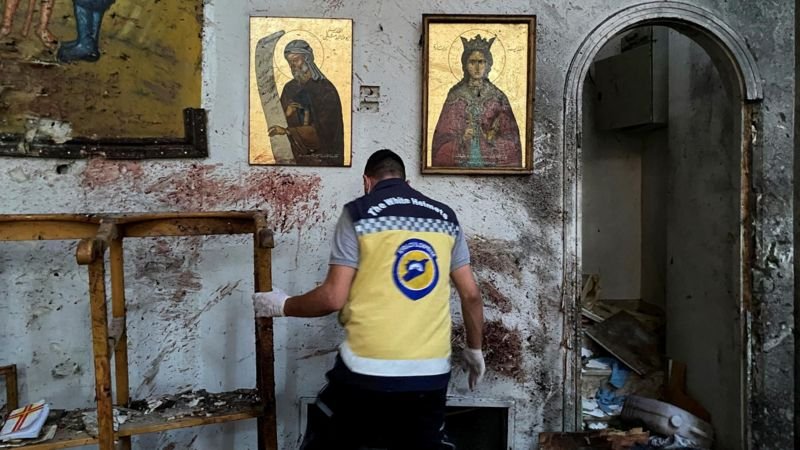


In a shocking act of violence, at least 25 individuals were killed and 63 others injured in a suicide bombing targeting a church in Damascus, Syria. The attack, which occurred during an evening service at the Greek Orthodox Church of the Prophet Elias in the Dweila neighborhood, has reignited fears over the persistent threat posed by extremist groups in the war-torn country. Authorities confirmed that the attacker, affiliated with the Islamic State (IS), entered the church armed with a firearm before detonating an explosive vest. This tragic incident is the first of its kind since Islamist rebel groups toppled President Bashar al-Assad’s regime, marking a new phase of sectarian violence in Syria.

I. The Attack on the Church in Damascus
1. Sequence of the Attack
The suicide bombing took place on Sunday evening, shaking the Greek Orthodox Church in central Damascus. According to eyewitnesses, a man armed with a weapon stormed into the church mid-service and began firing before activating an explosive device strapped to his body. The explosion left the altar shattered, glass scattered across the floor, and blood staining the walls.
Witnesses described a scene of horror and chaos. Lawrence Maamari, who was present during the attack, recalled that people inside the church attempted to stop the assailant before he blew himself up. Another local, identified only as Ziad, mentioned hearing gunshots followed by a powerful blast that sent shards of glass flying into nearby stores.
2. Official Response and Immediate Consequences
Syria’s health ministry confirmed the number of casualties while the interior ministry revealed the attacker’s ties to the Islamic State. Despite no direct claim of responsibility from IS, officials stated that this method and target align with the group’s tactics.
In response, Interior Minister Anas Khattab stated that investigative teams had been deployed to analyze the incident, labeling it a “reprehensible crime.” He stressed that such attacks would not derail the government’s pursuit of civil peace and national reconciliation.
II. Reactions from Religious and Political Leaders
1. Church and Patriarchate Condemnation
The Greek Orthodox Patriarchate of Antioch issued a powerful statement condemning the assault. It referred to the attack as an evil act that claimed the lives of innocents and violated the sanctity of the church. According to their report, the explosion occurred at the entrance, affecting both those inside and outside the building.
They called upon Syria’s interim authorities to fulfill their responsibilities in protecting citizens, especially religious minorities, from future violations.
2. International Outcry
The attack drew global condemnation. Greek Prime Minister Kyriakos Mitsotakis demanded concrete action from Syria’s transitional government to ensure the safety of all religious and ethnic groups.
Similarly, Geir Pedersen, the UN’s special envoy for Syria, urged Syrians to reject terrorism and extremism. U.S. special envoy Tom Barrack echoed this, emphasizing that acts of terror have no place in the inclusive society that Syrians are striving to build.
III. The Broader Context of Sectarian Violence in Syria
1. Historical Pattern of Targeting Minorities
The Islamic State has a long history of targeting religious minorities in Syria, including Christians and Shia Muslims. In 2016, the group orchestrated a deadly bombing near the Sayyida Zeinab shrine in Damascus, killing over 70 people. These actions are part of IS’s broader ideological campaign to eliminate groups that do not conform to their extremist beliefs.
2. Current Threat Landscape
Although the Islamic State was militarily defeated in Syria in 2019, the threat remains. According to a UN report released earlier this year, the group still has an estimated 1,500 to 3,000 fighters in Syria and neighboring Iraq. Many of these militants operate from the central Badia desert, which serves as a hub for planning attacks.
UN analysts warned that the ongoing political transition in Syria could provide fertile ground for IS to reestablish itself. The report also raised concerns about the potential for foreign fighter recruitment and a resurgence of cross-border terrorism.
3. Detention and Rehabilitation Challenges
Approximately 9,000 IS fighters are currently imprisoned in facilities across northeastern Syria. In addition, about 40,000 individuals—mostly women and children—linked to the group are being held in makeshift camps. The management and potential reintegration of these detainees remain major challenges for Syria and the broader international community.
IV. The Role of the Syrian Interim Government
1. Promises of Protection
Ahmed al-Sharaa, Syria’s interim president and leader of the Sunni Islamist group Hayat Tahrir al-Sham (HTS), has repeatedly vowed to protect ethnic and religious minorities. HTS, formerly affiliated with al-Qaeda, is listed as a terrorist group by the UN, US, and UK. Despite these assurances, recent months have seen two significant waves of sectarian violence, casting doubt on the government’s ability to maintain security.
2. Regional and Global Expectations
Following the church attack, both local and international actors have emphasized the urgent need for enhanced security measures. The Arab League joined the global community in condemning the attack, with Secretary-General Ahmed Aboul Gheit expressing hope that the Syrian authorities would step up efforts to combat terrorism.
There is growing pressure on the interim leadership to back its promises with action. Protecting vulnerable communities, especially during this transitional period, is seen as a litmus test for the legitimacy and effectiveness of Syria’s emerging government.
Conclusion
The suicide bombing at the Greek Orthodox Church in Damascus marks a devastating return of sectarian violence to Syria’s capital. With the death toll rising and the wounded grappling with trauma, the incident serves as a grim reminder that the fight against extremism is far from over. While authorities have vowed to uphold civil peace, the continued threat posed by IS, combined with the fragile nature of Syria’s political landscape, underscores the urgency of unified international and local efforts to ensure lasting security.
Only through tangible action, inclusive governance, and the protection of all citizens—regardless of faith or ethnicity—can Syria hope to rebuild a stable and peaceful society in the aftermath of years of conflict.