







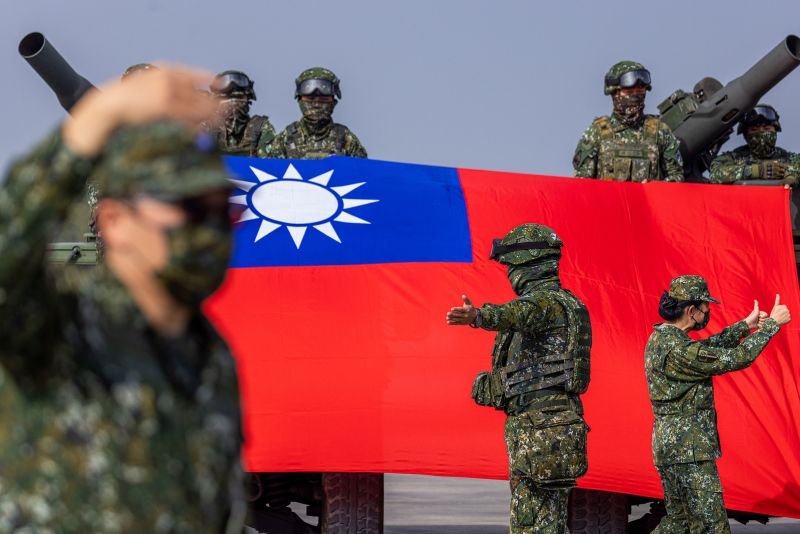


In recent months, Taiwan has found itself at the center of a national controversy following revelations of a widespread draft-dodging scandal. The case, which involves high-profile celebrities and influencers, has not only exposed vulnerabilities in the island’s conscription system but also reignited debates about military preparedness in the face of growing threats from China. As Taiwan ramps up defense reforms, the public’s disillusionment with conscription — marked by outdated training and widespread apathy — poses a serious challenge to national security and civic responsibility.

I. The Draft-Dodging Scandal That Shocked Taiwan
1. Celebrities Caught in the Act
The scandal came to light when authorities indicted 28 individuals for their roles in helping men evade military service. Prosecutors revealed that a four-person ring had assisted 24 able-bodied men in avoiding the draft by falsifying hypertension diagnoses, earning over NT$7.6 million (US$255,000) in the process. Among those implicated was actor Darren Wang, best known for his breakout role in Our Times, who allegedly paid NT$3.6 million (US$120,000) to obtain a fake medical exemption.
Investigations have extended to at least 11 other public figures, casting a spotlight on the lengths some individuals are willing to go to avoid military duty. The case has sparked outrage and intensified scrutiny of Taiwan’s conscription system, especially given the strategic importance of military readiness amid rising tensions with China.
2. Public Apathy Over Service
Rather than being driven by fear of the physical toll of service, many conscripts express frustration over the perceived futility of the experience. According to Chieh Chung, an associate research fellow at Taiwan’s Institute for National Defense and Security Research (INDSR), the primary deterrent is not physical hardship but “the sense of waste of time.” Recruits often spend their service performing non-combat tasks like mowing lawns, standing guard, or attending endless lectures.
II. A Flawed System: Taiwan’s Military Service Under Scrutiny
1. Outdated Training and Equipment
Taiwan introduced mandatory conscription in 1949 after retreating from mainland China during the civil war. Over the decades, however, the system has become a relic of the past. Modern-day conscripts often undergo minimal weapons training and use outdated rifles and artillery with limited live-fire experience.
Former conscripts have reported disorganized routines, lack of combat preparation, and inefficient use of time — a stark contrast to what is expected in a modern defense strategy. U.S. officials have quietly criticized the condition of Taiwan’s reserve forces, describing them as undertrained and underprepared for contemporary warfare. One American defense analyst noted that while millions of former conscripts exist on paper, they remain largely ineffective in reality due to shortened service periods and insufficient retraining.
2. Rising Draft Evasion Cases
Although the precise number of illegal draft-dodgers remains unclear, data from Taiwan’s Ministry of the Interior reveals a disturbing trend: suspected cases of obstructing military service increased from 309 in 2021 to 553 in 2023. This rise reflects a growing disenchantment with conscription and underscores the urgent need for systemic reform.
Wu Tzu-li of INDSR emphasizes that the effectiveness of a military force lies not only in its equipment but also in the quality of its personnel. “It is imperative to reform military service as quickly as possible,” he insists, arguing that true readiness depends on proper education and training.
III. Steps Toward Reform: Is Taiwan Moving in the Right Direction?
1. Government Response and New Policies
Recognizing the gravity of the situation, Taiwan’s government has taken significant steps to reform its conscription model. When former President Tsai Ing-wen assumed office in 2016, she committed to tackling the inefficiencies head-on. One of the most notable changes has been the extension of mandatory active-duty service from four months to one full year, effective January 2024.
The Defense Ministry has also revamped training programs to focus on realistic combat scenarios, including live-fire drills and tactical simulations. The goal is to ensure that every conscript gains not only discipline but also practical military skills. According to the Ministry’s statement, the new one-year training curriculum includes specialized instruction, base training, and joint military exercises.
2. Progress on the Ground
Some signs of improvement are beginning to emerge. Alex Chang, a conscript in his 20s, shared with CNN that training has become more intensive since the policy shift. “The sounds of bullets firing and grenades exploding have been going non-stop,” he noted, suggesting a shift toward more realistic combat preparedness.
However, military analysts caution that extending service time alone is not enough. As Chieh Chung points out, “The key is what kinds of training will be provided.” Without revamping training content and methods, longer service could still feel pointless to young recruits.
A U.S. official echoed these concerns, stating that while Taiwan is making headway in improving training realism, much remains to be done. “Updating equipment and restructuring reserve units are equally vital,” he added, noting the growing importance of asymmetric warfare tools such as drones and anti-air missiles.
IV. Lessons from South Korea: Patriotism Through Service
1. A Cultural Comparison
In stark contrast to Taiwan’s conscription culture, South Korea has turned military service into a symbol of integrity and national pride. High-profile stars like BTS members RM and V recently completed their service, saluting fans upon discharge to overwhelming public support. Military duty is often seen not as a burden but as a rite of passage — one that can enhance, rather than hinder, a celebrity’s career.
Even international sports icon Son Heung-min, though exempted from full service after winning gold at the 2018 Asian Games, completed a rigorous four-week basic training, further bolstering his public image.
2. The Role of Culture in Conscription
Military experts argue that Taiwan could benefit from adopting a similar mindset. If service were framed as an honorable and essential contribution to national defense, rather than a meaningless obligation, public attitudes might begin to shift. Building a sense of collective responsibility — especially as Beijing’s threats escalate — is crucial to bolstering Taiwan’s military readiness.
Conclusion: Will Taiwan’s Conscription System Evolve or Stagnate?
The draft-dodging scandal has brought long-standing issues within Taiwan’s military conscription system into sharp focus. As investigations unfold and reforms begin to take root, the country stands at a crossroads. Will it continue down the path of symbolic service, or seize this opportunity to implement meaningful change?
While recent measures — such as extended service periods and improved training — show promise, the ultimate success of Taiwan’s military reforms depends on consistent implementation, cultural transformation, and strategic modernization. For Taiwan to effectively deter aggression and safeguard its democracy, conscription must evolve into a system that produces skilled, committed, and combat-ready citizens.
As one former conscript warned, the fear is not that training has intensified — but that it may still be “the same old system, only longer.” Whether Taiwan can prove him wrong may determine the island’s resilience in the years to come.








