






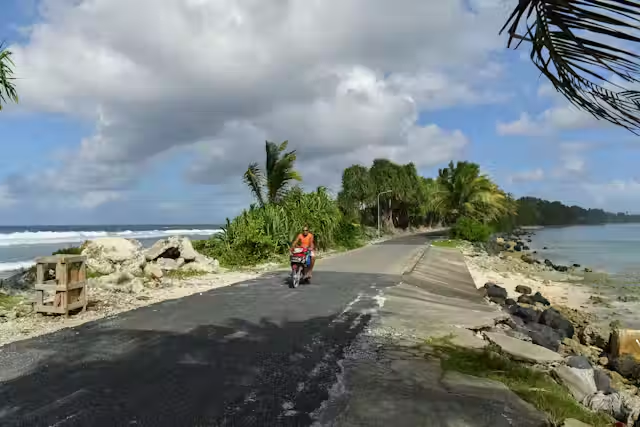


Nowhere in the world is the climate crisis felt more acutely than in the Pacific. For the small island developing states (SIDS) scattered across this vast ocean, climate change is not a distant threat—it is an existential emergency. Rising sea levels, intensifying tropical cyclones, changing rainfall patterns, coral bleaching, and ocean acidification are threatening the very survival of entire nations. From Kiribati and Tuvalu to the Marshall Islands and Fiji, Pacific Islanders face the grim possibility of becoming climate refugees within their own lifetimes.

This article explores the existential dimensions of climate change in the Pacific, analyzing the physical, economic, cultural, and geopolitical consequences of environmental transformation. It also examines how Pacific nations are fighting back—through diplomacy, adaptation strategies, legal innovations, and community-based resilience efforts—against a crisis they did not create but must confront head-on.
1. The Geography of Vulnerability
The Pacific region is home to thousands of islands, many of which are low-lying atolls barely a meter above sea level. Countries like Tuvalu, Kiribati, and the Marshall Islands are particularly vulnerable due to:
-
Low elevation
-
Lack of freshwater resources
-
Dependence on fragile ecosystems
-
Limited economic diversification
For these countries, sea level rise is not a theoretical problem—it is already resulting in coastal erosion, salinization of farmland, and the displacement of communities. Even moderate projections by the Intergovernmental Panel on Climate Change (IPCC) indicate a 1-meter rise by 2100, which could render many of these islands uninhabitable.
2. The Economic Toll
Climate change is undermining the economic foundations of Pacific nations, which typically depend on:
-
Fisheries
Warmer oceans and coral bleaching have disrupted fish migration patterns and diminished fish stocks. This not only threatens food security but also critical export revenue. -
Tourism
Pristine beaches and coral reefs are key attractions. Cyclones, flooding, and ecosystem degradation deter tourists and damage infrastructure. -
Agriculture
Changes in rainfall and rising salinity levels are reducing crop yields, increasing food imports, and exacerbating poverty. -
Aid Dependency
Many Pacific nations rely on foreign aid, which may be redirected due to geopolitical shifts or global financial crises, compounding their vulnerability.
3. Cultural Loss and Identity
In the Pacific, land is not just property—it is identity, heritage, and spirituality. Losing land to the sea means more than relocating homes; it means the loss of burial grounds, ancestral knowledge, and cultural continuity.
For example:
-
In Kiribati, elders fear that forced migration will erode their language, customs, and kinship structures.
-
Tuvaluans worry about maintaining national identity if their population becomes permanently dispersed across Australia, New Zealand, and Fiji.
-
Rituals tied to tides, winds, and stars are becoming obsolete as climate patterns change unpredictably.
This is why Pacific leaders often speak of climate change not only as an ecological or economic issue, but as a cultural genocide in slow motion.
4. Climate Migration and Displacement
Climate-induced displacement is no longer hypothetical in the Pacific. Entire communities have already relocated:
-
In Fiji, the village of Vunidogoloa was moved inland due to rising seas and flooding.
-
Kiribati has purchased land in Fiji as a “migration with dignity” strategy.
-
In Papua New Guinea, the Carteret Islands are experiencing forced evacuations due to disappearing land.
Yet, international frameworks for climate refugees remain weak. The 1951 Refugee Convention does not recognize environmental degradation as a basis for asylum. This legal gap leaves climate-displaced Pacific Islanders without guarantees of relocation rights, compensation, or citizenship.
5. Political Leadership and Global Diplomacy
Despite their small size and limited resources, Pacific nations have become powerful voices in global climate diplomacy.
-
The Pacific Islands Forum (PIF) serves as a regional bloc advocating for ambitious climate targets.
-
In 2015, Pacific diplomacy played a crucial role in shaping the Paris Agreement, especially around the 1.5°C goal.
-
The Suva Declaration (2015) articulated the region’s unified stance for greater climate action and financing.
-
Pacific leaders have pressured high-emitting countries to honor their Nationally Determined Contributions (NDCs).
Countries like Fiji and Marshall Islands have also chaired UN climate talks, bringing moral authority to the international stage and insisting on climate justice and equity.
6. Legal Innovation and Sovereignty Preservation
In response to rising seas, some Pacific countries are turning to international law to protect their sovereignty.
-
Maritime Zones: Several states are proposing that maritime boundaries be preserved even if land territory disappears, ensuring continued control over exclusive economic zones (EEZs).
-
Advisory Opinions: Vanuatu led an initiative seeking an ICJ advisory opinion on the obligations of states under international law to protect the environment and future generations.
-
Litigation: Island nations are exploring legal action against polluting states and fossil fuel corporations, claiming loss and damage compensation under international law.
These legal approaches mark a shift from passive victimhood to active legal resistance, reinforcing sovereignty even amid physical erosion.
7. Adaptation and Resilience on the Ground
Local communities across the Pacific are not waiting for global agreements. They are innovating on the frontlines of adaptation:
-
Mangrove Reforestation: Coastal villages are planting mangroves to reduce erosion and buffer storm surges.
-
Rainwater Harvesting: Where freshwater is scarce, communities have implemented cistern systems to capture rainwater for drinking and irrigation.
-
Floating Agriculture: In places like Bangladesh and the Solomon Islands, floating gardens are emerging as adaptive agricultural techniques.
-
Traditional Knowledge: Indigenous environmental knowledge is being integrated into early warning systems and land management practices.
Though under-resourced, these grassroots initiatives embody resilience, ingenuity, and cultural continuity.
8. The Role of External Powers and Climate Finance
Pacific nations have repeatedly emphasized that climate financing is not charity—it is a reparation for historical emissions.
-
Green Climate Fund (GCF): Accessing funds from multilateral sources like the GCF is critical but often mired in bureaucratic hurdles.
-
Development Aid: Countries like Australia, New Zealand, China, and Japan provide aid packages that blend climate funding with broader strategic interests.
-
Blue and Green Bonds: Innovative financial instruments are emerging to fund renewable energy, marine conservation, and climate-proof infrastructure.
Yet, climate finance remains woefully inadequate compared to the scale of need. According to the UN, Pacific nations require billions annually for adaptation—but receive only a fraction.
9. Energy Transition and Green Innovation
Despite their vulnerabilities, Pacific nations are investing in renewable energy to reduce reliance on imported fossil fuels:
-
Solar Grids: Countries like Samoa and Tonga are increasing rural electrification through solar mini-grids.
-
Wind Energy: Vanuatu and Fiji are experimenting with wind farms to diversify their energy mix.
-
Hydropower: Papua New Guinea leverages mountainous terrain for small-scale hydroelectric projects.
-
Ocean Energy: Wave and tidal energy remain nascent but promising, given the region’s geography.
Green energy not only mitigates emissions but enhances resilience, autonomy, and energy security.
10. Youth Movements and the Moral Narrative
Pacific youth have become some of the most compelling climate activists on the global stage.
-
Movements like Pacific Climate Warriors use the slogan “We are not drowning, we are fighting” to assert agency and dignity.
-
Youth leaders have spoken at COP summits, challenging world leaders with stories of their disappearing homelands.
-
Cultural activism—through storytelling, music, and art—is being used to sustain hope and memory amid uncertainty.
These youth-led movements reframe the climate narrative—from one of despair to defiance and empowerment.
Conclusion: The Frontline of a Global Crisis
The Pacific region embodies the moral heart of the climate crisis. Though responsible for a minuscule share of global emissions, Pacific Island nations are bearing the brunt of the consequences. Their battle against climate change is not just about survival—it is a fight to preserve cultures, sovereignties, and futures.
Yet, this existential fight also reveals extraordinary courage, creativity, and leadership. From planting mangroves and passing legal resolutions to confronting world leaders with unwavering conviction, the Pacific is doing everything possible to stay afloat.
But time is running out. If the world fails the Pacific, it sends a message that no place is truly safe, and that the global order is incapable of protecting the most vulnerable. Conversely, saving the Pacific is saving the planet—a litmus test of our collective humanity.