







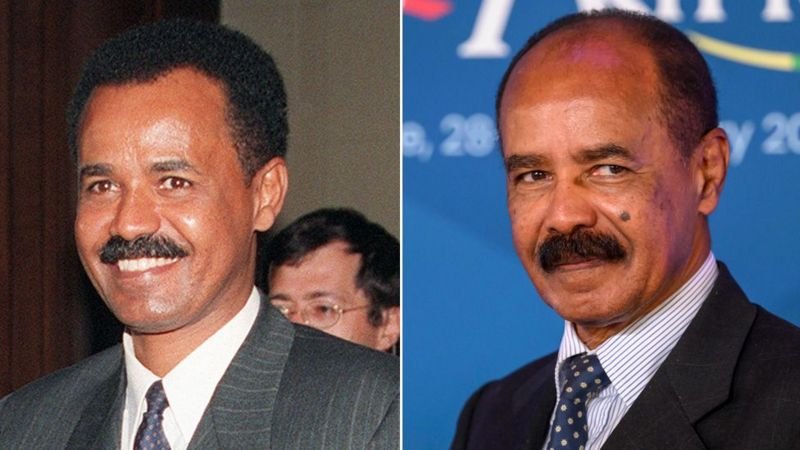


Once hailed as a visionary reformist among Africa’s new generation of leaders, Eritrea’s President Isaias Afwerki has now spent over 32 years in power. Rising to prominence after Eritrea’s independence, he was once seen as a beacon of hope. Yet over the decades, his leadership has taken a repressive turn, dashing the democratic aspirations he once promised and leaving Eritrea’s people longing for change.

I. A Promising Beginning: Hope for Democracy
1. The Early Years of Independence
In the early 1990s, Isaias Afwerki emerged as a charismatic leader of the Eritrean People’s Liberation Front (EPLF), which defeated Ethiopia in 1991, securing de facto independence for Eritrea. Celebrated for his military leadership, he became the head of state following the formal declaration of independence in 1993. At the time, Eritreans and international observers alike held high expectations for the country’s democratic future.
2. Vows of Reform and the 1997 Constitution
At the 1993 Cairo summit, Isaias harshly criticized African leaders who clung to power and pledged that Eritrea would chart a different course. In 1997, Eritrea ratified a new constitution designed to establish the rule of law, ensure political pluralism, and set the foundation for democratic elections. Isaias, who was supposed to serve as a transitional president, gave hope that elections and multiparty governance were on the horizon.
II. A Shift in Direction: War, Suppression, and Control
1. The Ethiopia-Eritrea Border War
However, in 1998, the promise of democracy was derailed when a war broke out between Eritrea and Ethiopia over a disputed border area. The conflict, which lasted until a peace agreement in 2000, became a pretext for postponing national elections indefinitely. This marked the beginning of a gradual but determined move away from democratic processes.
2. Silencing Dissent: The G-15 and Media Crackdown
By 2001, internal pressure mounted as former allies and government officials, known collectively as the G-15, issued a public letter criticizing Isaias’ increasingly autocratic rule. They demanded elections and the implementation of the constitution. However, that same year, while global attention was fixated on the 9/11 attacks, the Eritrean government clamped down. Independent newspapers were shuttered, journalists and editors were imprisoned, and the G-15 members were arrested—most have not been seen since.
III. Isaias’ Vision: One Leader, One Nation
1. The Death of Democracy
In subsequent interviews, Isaias expressed his disdain for democratic systems, calling them a “mess.” He also declared that he had no intention of ever participating in a political party. The ruling People’s Front for Democracy and Justice (PFDJ) was portrayed not as a party, but as the embodiment of the Eritrean nation itself. This rhetoric signaled a complete abandonment of the multiparty promises of the 1990s.
2. Consolidation of Power
By 2002, Isaias unofficially dissolved the transitional assembly and effectively dismantled cabinet meetings. Government ministries were rendered symbolic, with many vacant leadership roles or officials with no real authority. State functions were absorbed into the presidency, concentrating power entirely in his hands.
IV. Cracks in the Regime: Coup Attempt and Constitution Rejection
1. The 2013 Coup Attempt
Despite the tight control, dissent simmered beneath the surface. In 2013, a group of senior military officers attempted a coup by taking control of national media stations and calling for the implementation of the 1997 constitution. The effort failed, resulting in a brutal crackdown. Many officials were arrested, and the coup leader died by suicide to avoid capture.
2. Abandoning the 1997 Constitution
Following the attempted coup, Isaias announced plans to create a new constitution in 2014, calling the 1997 version “dead.” Yet no progress was made, reinforcing the belief that the proposal was merely a distraction to deflect criticism.
V. The Human Cost: A Nation in Stasis
1. Economic Decline and Forced Conscription
Today, Eritrea faces severe economic hardships. According to the World Bank, the economy suffers from underdeveloped infrastructure, limited private sector activity, and overreliance on state control. The president has refused international aid, arguing that it breeds dependency, while citizens—especially the youth—are subjected to indefinite national service, justified by ongoing tensions with neighboring countries.
2. Mass Exodus of Citizens
Trapped in a system devoid of freedom and opportunity, Eritreans continue to flee the country in large numbers. Over the past two decades, hundreds of thousands have risked their lives to escape, with Eritreans now among the top nationalities receiving asylum in countries like the United Kingdom.
VI. Present Realities: Isolation and Speculation
1. Retreat from Public Life
Since 2014, Isaias has largely retreated from public life, spending most of his time at his rural residence near the Adi Hallo dam. There, he hosts both officials and citizens, centralizing all decision-making within his personal sphere. Cabinet meetings have not occurred since 2018, and the government operates with little transparency or accountability.
2. No Succession Plan
As Isaias nears 80 years of age, concerns about the country’s future intensify. Reports of an attempt to position his eldest son as successor were rejected internally, and no alternative plan for leadership transition is apparent. This vacuum raises fears of chaos should the regime abruptly end.
VII. The Diaspora Divide: Criticism vs. Support
While many Eritreans oppose Isaias’ rule, segments of the population—especially those connected to the military and the diaspora—still support him. Some view Western nations as antagonistic to Eritrean sovereignty and believe Isaias is defending national dignity against external interference.
Conclusion: Eritrea’s Long Wait for Change
After more than three decades in power, President Isaias Afwerki’s legacy is deeply contested. Once a celebrated freedom fighter and reformist, he now presides over one of the most closed and repressive regimes in the world. Eritrea’s democratic dreams have been crushed under the weight of authoritarianism, with no elections, no functioning constitution, and no free press.
As the country remains in political limbo, many Eritreans continue to risk everything to find freedom elsewhere. The hope that once defined the nation’s independence has given way to fear, disillusionment, and longing for genuine change. With no clear successor or roadmap for reform, Eritrea’s future remains uncertain—held hostage by a single man’s enduring grip on power.








