







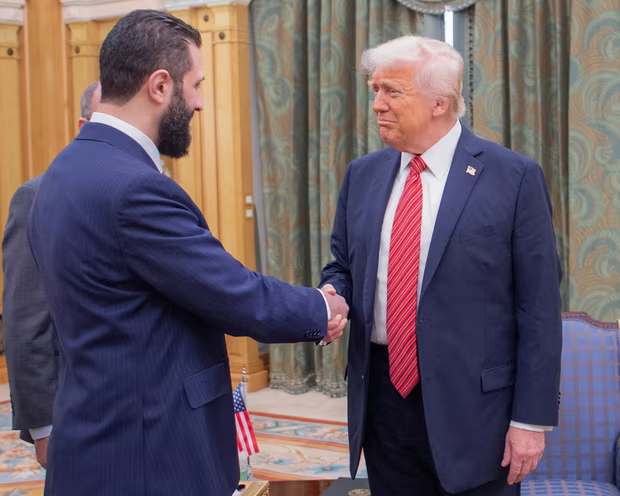


In a pivotal foreign policy move, former U.S. President Donald Trump has issued an executive order lifting a substantial portion of the financial sanctions previously imposed on Syria. According to the White House, the decision is aimed at promoting regional stability and enabling Syria’s reconstruction after the ousting of long-time leader Bashar al-Assad. While some restrictions remain, the executive action signals a broader shift in Washington’s stance on Damascus, with potential implications for diplomacy, economic recovery, and regional alliances.


I. A NEW STRATEGIC APPROACH TO SYRIA
1. Executive Order Ends Broad Sanctions Program
The newly signed executive order formally cancels a 2004 measure that froze Syrian government assets and curtailed exports to the country due to its chemical weapons activities. This move effectively dismantles a significant portion of Washington’s long-standing sanctions architecture targeting the Syrian regime.
A White House spokesperson confirmed that the directive is intended to “terminate the United States’ sanctions programme on Syria,” although it does not fully absolve the country of all financial restrictions.
2. Remaining Restrictions and Legal Constraints
Despite this sweeping rollback, several key sanctions will remain in place. These include congressional sanctions under the Caesar Syria Civilian Protection Act of 2019, which targets reconstruction financing, natural gas development, and sanctions related to Syria’s designation as a state sponsor of terrorism.
The White House clarified that these provisions would continue to exert pressure on individuals and entities linked to human rights abuses, terrorism, chemical weapons, and illicit activities.
II. POTENTIAL FOR DIPLOMATIC LEVERAGE AND ECONOMIC REVIVAL
1. Direction to Reassess Key Sanctions
Trump’s executive order tasks Secretary of State Marco Rubio with reviewing several measures. This includes evaluating the suspension of Caesar Act sanctions, lifting controls on exporting specific goods, and potentially easing limitations on foreign aid. The order also calls for a reexamination of Syria’s status as a state sponsor of terrorism and a reassessment of the designation of Syrian leader Ahmed al-Sharaa as a terrorist figure.
These steps, while not immediately removing all barriers, could serve as building blocks for future normalization and multilateral discussions, particularly those involving the United Nations.
2. Encouraging Foreign Investment and Infrastructure Development
Syrian Foreign Minister Asaad Hassan al-Shaibani welcomed the move, describing it as a turning point for the war-torn nation. He emphasized that easing sanctions could jumpstart critical development projects and restore basic services.
“By removing this major obstacle to economic recovery, the doors to long-awaited reconstruction and development are opened,” Shaibani stated. “This paves the way for the safe and dignified return of displaced Syrians to their homeland.”
III. BALANCING US INTERESTS AND GEOPOLITICAL GOALS
1. Focus on Stabilizing Syria While Retaining Strategic Pressure
The White House underscored that the administration’s aim is not to support Syria unconditionally, but to create a pathway for peace and stability without compromising U.S. national security interests.
“President Trump wants Syria to succeed – but not at the expense of US interests,” a statement from the administration read. The executive order, therefore, keeps targeted sanctions on Assad, members of his former regime, and actors involved in chemical weapons, narcotics trafficking, terrorism, and human rights violations.
2. Post-Assad Transition and the Push for Reengagement
Trump’s executive action follows a recent meeting with Ahmed al-Sharaa, who assumed leadership after Assad’s December ouster. Sharaa’s transitional government has reportedly struggled with basic administrative functions, particularly in paying civil servants and initiating infrastructure repairs.
With the easing of sanctions, Trump aims to provide the transitional administration with the financial breathing room needed to stabilize governance and attract both regional and international investment.
Acting Under-Secretary for Terrorism and Financial Intelligence Brad Smith explained that lifting financial restrictions would allow Syria to reenter the global economy. “This sets the stage for global commerce and galvanizes investments from neighbors in the region as well as from the United States,” Smith said.
IV. REGIONAL DIPLOMACY AND THE PATH AHEAD
1. Navigating the Israel-Syria Relationship
While the Abraham Accords—Trump’s signature initiative to normalize ties between Arab states and Israel—remain a diplomatic benchmark, the administration is taking a measured approach regarding Syria’s position. Officials indicated that the U.S. would avoid pushing for immediate recognition of territorial claims or forcing hasty resolutions.
A senior administration official commented, “We’re going to come to a mutuality of understanding… there’s going to be metrics and milestones. And over this trust, those lines become illusory.”
This statement hints at a long-term vision of reconciliation and border agreements based on mutual confidence-building rather than unilateral demands.
2. Maintaining Pressure on Malign Actors
Despite the softened stance toward the new Syrian government, the Trump administration reiterated its firm opposition to Islamic State affiliates, Iranian proxy groups, and actors involved in Syria’s chemical weapons programs. These groups remain under U.S. sanction, and the administration vowed continued efforts to neutralize their influence in the region.
Press Secretary Karoline Leavitt emphasized, “The order will remove sanctions on Syria while maintaining sanctions on the former president, Assad, his associates, human rights abusers, drug traffickers, persons linked to chemical weapons activities, Islamic State and their affiliates, and Iranian proxies.”
Conclusion
Trump’s decision to ease sanctions on Syria marks a significant turning point in U.S. foreign policy toward the country, following the fall of Bashar al-Assad. While it opens the door for economic recovery and diplomatic reintegration, it also preserves pressure on malign actors and ensures that U.S. strategic interests remain protected. The move has been welcomed by Syria’s transitional government and is expected to unlock foreign aid, encourage regional investment, and initiate broader talks on peace and normalization.
However, this policy shift will require careful monitoring, measured diplomacy, and international cooperation to ensure that the lifting of sanctions leads to genuine progress—and not further instability.








