





The arrest of four staff members from the Turkish satirical publication LeMan has ignited a national and international debate over freedom of expression and the boundaries of religious sensitivity. The arrests follow public outrage over a cartoon allegedly depicting the Prophet Muhammad, a depiction considered offensive in Islam. While the magazine denies any such intention, Turkish authorities have launched a criminal investigation, intensifying concerns about press freedom in the country.
I. Arrests Spark National Outrage and Protests
1. Government Condemns “Blasphemous” Cartoon
Turkey’s Interior Minister Ali Yerlikaya labeled the cartoon published by LeMan as “shameless,” confirming the arrests of the magazine’s editor-in-chief, cartoonist, graphic designer, and institutional director. Yerlikaya also posted video footage of the arrests online, calling the cartoon a “vile drawing” that offended religious values.
Justice Minister Yilmaz Tunç echoed similar sentiments, stating that the cartoon not only offended Islam but also “disrupted societal harmony.” He emphasized that the Chief Public Prosecutor’s Office had already begun legal proceedings for “publicly insulting religious values.”
2. Protests Erupt Outside Magazine’s Office
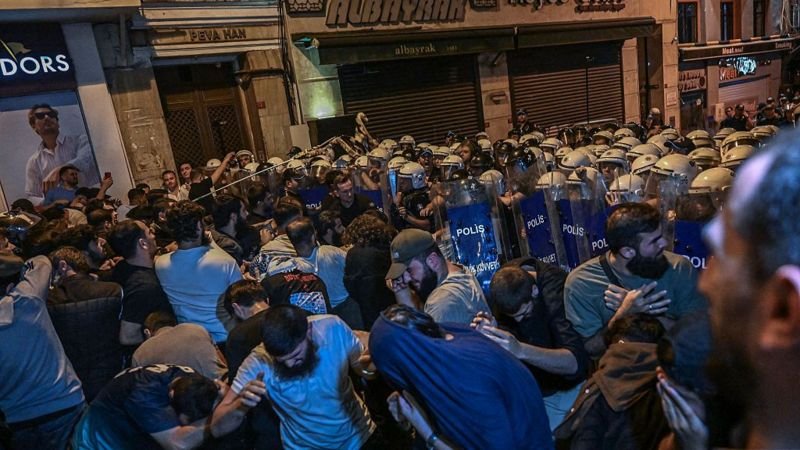
The cartoon sparked immediate public backlash. On Monday, riot police were deployed in Istanbul as hundreds of demonstrators gathered outside LeMan‘s headquarters. The protestors chanted slogans such as “tooth for tooth, blood for blood, revenge, revenge.”
Agence France-Presse (AFP) reported that police used rubber bullets and tear gas to disperse the crowd as tensions escalated. The intense reaction underscored the deep sensitivities around religious representation in Turkey, a predominantly Muslim nation with a strong nationalist and religious sentiment.
II. Magazine Defends Its Content and Denies Blasphemy
1. LeMan Rejects Accusations of Depicting the Prophet
In a statement posted on social media platform X, LeMan firmly denied that the cartoon referenced or depicted the Prophet Muhammad. The magazine expressed regret toward readers who felt offended but maintained that the interpretation was incorrect.
“The drawing does not depict the Prophet Muhammad in any way,” LeMan stated, stressing that it was a misreading to assume otherwise. “You have to be very malicious to interpret the cartoon in this way,” the publication said.
The controversial image, which circulated widely online, showed two winged characters floating over a besieged city. One character introduces himself as “Muhammed” and the other as “Musa” (Moses in Turkish). The implication, according to LeMan, was symbolic and intended to highlight the plight of Muslims, especially in the context of violence in Gaza.
2. Apology to Readers, Not Authorities
Although LeMan offered an apology to “well-intentioned readers who feel hurt,” it stopped short of conceding wrongdoing. The editorial team insisted the cartoon was meant to express solidarity with Muslim victims, particularly those affected by Israeli attacks.
The magazine argued that the cartoon was misunderstood, asserting that the intent was to portray the dignity of oppressed Muslims. It firmly opposed claims that the drawing constituted an insult to Islam or its sacred figures.
III. Press Freedom Under Scrutiny
1. Arrests and Warrants Raise Free Speech Concerns
The arrest of LeMan employees has drawn comparisons to past incidents of violent and legal retaliation against satirical media. Authorities have also issued arrest warrants for additional senior members of the magazine, increasing fears of a broader crackdown.
The magazine’s editor-in-chief, Tuncay Akgün, who is currently based in Paris, spoke to AFP about the gravity of the situation. He described the backlash as a deliberate misinterpretation of the magazine’s content and warned that the controversy mirrors the rhetoric and circumstances that surrounded the 2015 Charlie Hebdo attack in France.
2. Echoes of Charlie Hebdo and Growing Censorship
Akgün’s comparison to Charlie Hebdo is chilling. In 2015, gunmen stormed the French satirical magazine’s offices after it published cartoons of the Prophet Muhammad, killing 12 people. The event became a defining moment in the global debate over freedom of speech versus religious reverence.
Though LeMan has not faced physical violence, the arrests and public condemnation suggest a narrowing space for critical or satirical expression in Turkey. The incident adds to a growing list of legal challenges faced by Turkish journalists, writers, and artists in recent years.
IV. Political and Religious Dimensions
1. A Sensitive Climate for Religious Expression
Islamic teachings prohibit any visual representation of the Prophet Muhammad, viewing such depictions as deeply disrespectful or even blasphemous. Given the historical sensitivity, many Islamic-majority countries have strict laws protecting religious figures from perceived mockery.
In Turkey, which straddles secular and Islamic traditions, such matters are especially volatile. The current administration under President Recep Tayyip Erdoğan has increasingly emphasized religious and nationalist values, making the environment more hostile for dissenting or controversial content.
2. Balancing Faith and Artistic Freedom
The incident reignites a long-standing debate: how can a democratic society balance respect for religious beliefs with the freedom to express dissenting or critical views?
While officials argue that LeMan crossed a moral and legal boundary, critics see the arrests as part of a broader pattern of silencing critical voices under the guise of protecting religion. The tension between these opposing views continues to shape the media landscape in Turkey and beyond.
Conclusion
The arrest of LeMan’s editorial team over a controversial cartoon has ignited a storm of protest, legal action, and philosophical debate in Turkey. While the government defends its crackdown as necessary to protect religious sentiments, the magazine insists that its work was both misinterpreted and unjustly vilified. The incident serves as a reminder of the fragile boundary between free expression and religious reverence, especially in regions where both are passionately upheld.
As the investigation unfolds and legal actions proceed, the fate of LeMan could set a significant precedent for press freedom in Turkey. Whether it results in harsher media restrictions or sparks a broader conversation about the limits of satire in a religious society remains to be seen.