






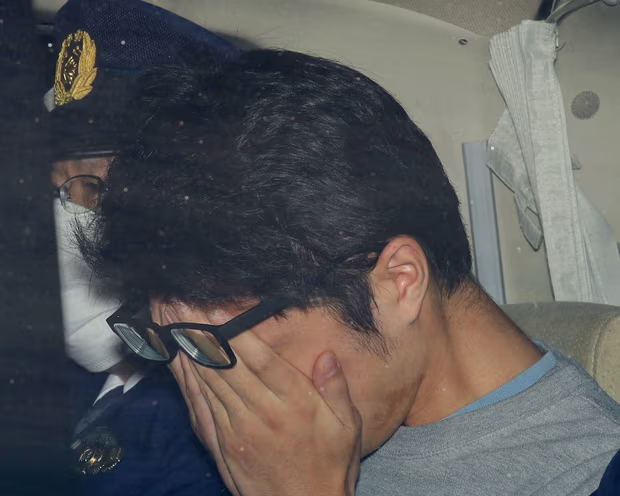


In a case that shocked Japan and the wider world, the man known as the “Twitter killer” has been executed, marking the country’s first use of capital punishment in nearly two years. Takahiro Shiraishi, who admitted to murdering and dismembering nine people he met through the social media platform X (formerly Twitter), was hanged on Friday, closing a chilling chapter in Japanese criminal history.


I. The Crimes of Takahiro Shiraishi
1. Murders That Stunned the Nation
In 2017, Shiraishi committed a series of gruesome killings that left nine people—mostly women between the ages of 15 and 26—dead. He connected with his victims online, preying on those who expressed suicidal thoughts. Under the guise of offering them support in ending their lives, Shiraishi lured them to his apartment in Zama, a city near Tokyo.
2. Confessions and Modus Operandi
Once at his home, he strangled his victims, dismembered their bodies, and stored the remains in coolers and containers scattered around his small apartment. According to reports, he later confessed to all nine murders, admitting he targeted vulnerable individuals online and exploited their despair for his own gratification.
II. Government Response and Execution
1. Justice Minister Justifies Execution
Keisuke Suzuki, Japan’s justice minister, announced the execution during a press conference on Friday. “After much careful consideration, I ordered the execution,” he said, describing the crimes as including “robbery, rape, murder, destruction and abandonment of corpses.” Suzuki detailed how Shiraishi not only killed his victims but also disposed of their remains in brutal and callous ways.
2. Legal Process and Timing
Shiraishi’s death sentence was handed down in 2020 after he waived his right to appeal, clearing the way for the execution to proceed. Japanese law requires executions to be carried out within six months of a final verdict when no appeals remain. However, in practice, executions are often delayed for years, adding to criticism of the system’s psychological toll on death row inmates.
III. The Capital Punishment System in Japan
1. Japan’s Global Position on the Death Penalty
Japan remains one of only two G7 nations—alongside the United States—that still practices capital punishment. Public support for the death penalty remains high in Japan, with an official 2024 government survey revealing that 83% of respondents viewed it as “unavoidable” in certain cases.
2. Secrecy and Mental Health Concerns
The Japanese execution system is highly secretive. Inmates are kept in solitary confinement and often receive no prior notice before being taken for execution. Typically, prisoners are informed on the morning of their hanging, a practice that has drawn criticism from human rights groups for causing extreme mental distress. As of December 2023, 107 inmates remained on death row awaiting execution.
IV. Historical Context and Recent Executions
1. Previous Executions in Recent Years
Prior to Shiraishi, Japan’s last execution took place in 2022 when Tomohiro Kato was hanged for a 2008 mass killing in Tokyo’s Akihabara district. In that attack, Kato drove a two-ton truck into a crowd before going on a stabbing spree, resulting in seven deaths. The event shocked the nation and further cemented public support for capital punishment in cases involving mass violence.
2. Aum Shinrikyo Cult Executions
One of the most notable uses of capital punishment in recent memory was the 2018 execution of Shoko Asahara and 12 other senior members of the Aum Shinrikyo doomsday cult. The group was behind the deadly 1995 sarin gas attack on Tokyo’s subway system, which left 14 dead and thousands injured. These executions were carried out in waves and were accompanied by heightened security measures across the country.
V. Public Reaction and Ethical Debate
1. Continued Public Support
Despite international criticism, Japan’s general population continues to support the use of the death penalty, particularly for heinous crimes involving multiple victims. The brutal nature of Shiraishi’s crimes—exploiting suicidal individuals and dismembering their remains—fueled national outrage and reinforced public consensus on the need for severe punishment.
2. Human Rights and International Scrutiny
Nevertheless, Japan’s handling of capital punishment remains a point of contention internationally. Human rights organizations, including Amnesty International, have long condemned the psychological impact of solitary confinement, the last-minute notifications, and the lack of transparency in the system. Critics argue that the secrecy surrounding executions denies inmates the dignity of due process and leaves their families in prolonged anxiety.
VI. Legal and Moral Considerations
1. Debate Over Reform
Legal scholars and human rights advocates have been calling for reform, including clearer timelines for execution, improved psychological support for inmates, and more transparency in the legal process. However, with public opinion strongly in favor of capital punishment and a government that sees the practice as a deterrent, reform efforts have seen little traction.
2. Victims’ Families and Public Closure
While some question the morality of the death penalty, others argue that executions such as Shiraishi’s provide closure to the families of victims and reaffirm justice in cases of unimaginable cruelty. In Japan, the death penalty is often seen not just as a legal recourse but also as a necessary response to safeguard societal norms and public peace.
Conclusion
The execution of Takahiro Shiraishi, Japan’s infamous “Twitter killer,” has once again spotlighted the nation’s unwavering stance on capital punishment. His crimes were chilling in both method and motive, targeting the emotionally vulnerable and ending nine lives in horrific ways. While human rights advocates continue to question Japan’s secretive and psychologically taxing execution practices, overwhelming public support suggests that the death penalty is unlikely to be abolished any time soon. As Japan seeks to balance justice, transparency, and public opinion, the ethical debate over capital punishment remains unresolved.