









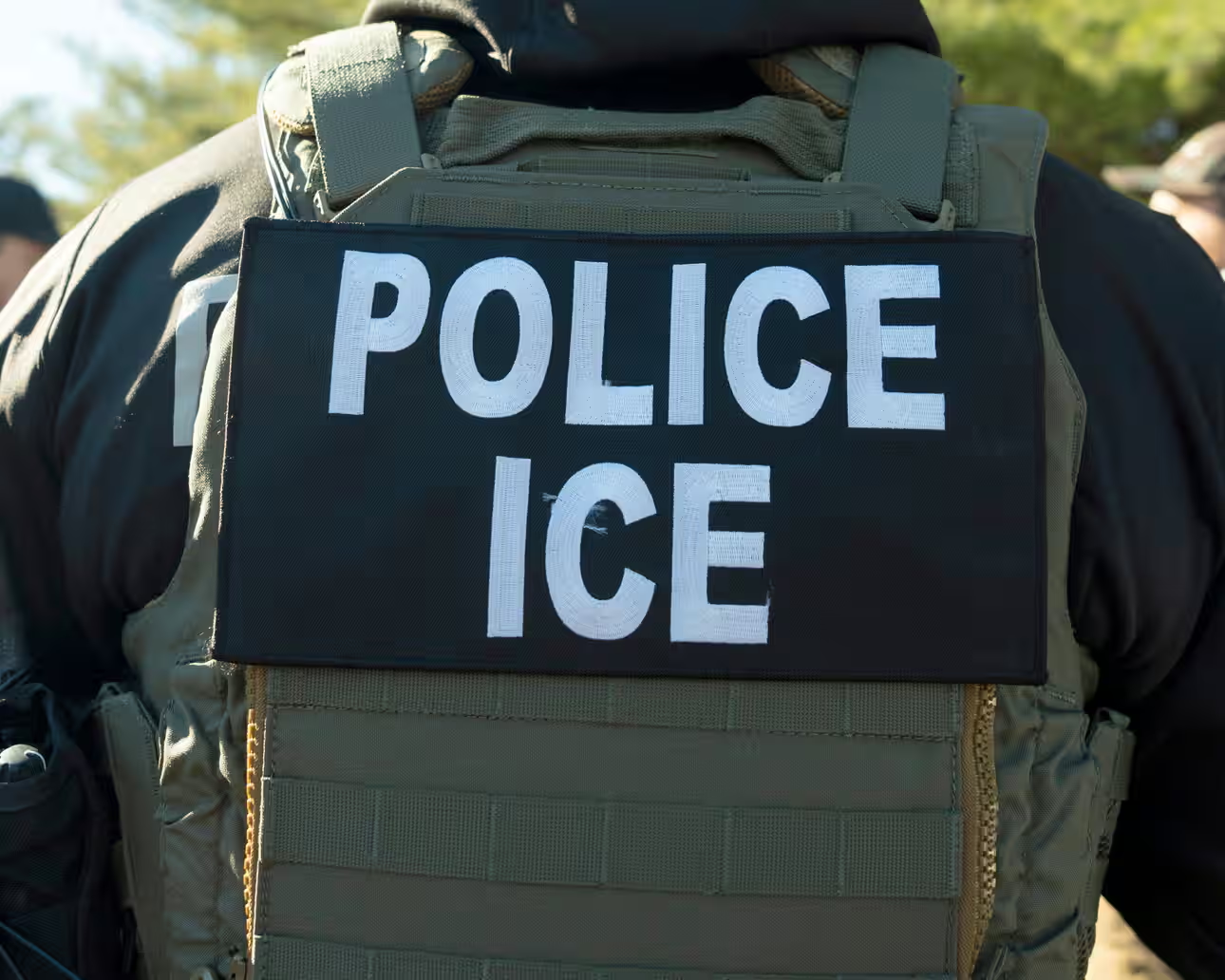
More than half a million Haitians currently residing in the United States are now facing the imminent threat of deportation after the Trump administration moved to end their Temporary Protected Status (TPS). This humanitarian program, initially intended to shield individuals from countries experiencing severe crises, is now being withdrawn despite ongoing instability and violence in Haiti. The announcement has drawn sharp criticism from immigrant advocates, human rights organizations, and members of the Haitian-American community.


I. Background of Temporary Protected Status for Haitians
1. TPS Origins and Haitian Inclusion
The Temporary Protected Status program was established by Congress in 1990 to offer safe haven to individuals from nations experiencing armed conflicts, environmental disasters, or other extraordinary conditions. Haitians were granted TPS following the catastrophic 2010 earthquake that struck Port-au-Prince, killing tens of thousands and displacing countless more. Over the years, the status has been periodically renewed due to persistent instability and natural disasters in the country.

2. The Trump Administration’s Policy Shift
In a move consistent with its broader anti-immigration agenda, the Trump administration announced that Haiti’s TPS designation would end on September 2, 2025. Officials from the Department of Homeland Security (DHS) stated that conditions in Haiti had improved sufficiently to allow for the safe return of its nationals. A DHS spokesperson said, “This decision restores integrity in our immigration system and ensures that temporary protective status is actually temporary.”
II. Escalating Violence and Humanitarian Crisis in Haiti
1. A Nation in Chaos Since 2021
Haiti has plunged deeper into crisis since the assassination of President Jovenel Moïse in 2021. Armed gangs have seized control of much of the capital, Port-au-Prince, effectively destabilizing the government and driving widespread terror. These groups are heavily armed and politically connected, and have overthrown the prime minister, creating a power vacuum and intensifying the lawlessness in the region.
2. Warnings from U.S. and Foreign Governments
The U.S. embassy in Haiti recently issued a stark warning to American citizens, urging them to leave the country immediately due to rising violence. “Depart Haiti as soon as possible,” read a post on the embassy’s official social media account. International organizations and governments, including the UK Foreign Office, have similarly advised against any travel to Haiti, citing the “unpredictable” security environment, risk of kidnapping, and widespread gang violence.
III. Contradictions Between Policy and Reality
1. DHS Statement Under Fire
While DHS maintains that the environmental conditions in Haiti have improved, critics argue this rationale is unfounded and dangerous. Tessa Petit, executive director of the Florida Immigrant Coalition and a Haitian immigrant herself, described the DHS statement as a blatant falsehood. “This is a complete lie stating that the situation in Haiti has improved enough that it is safe for Haitian citizens to return home,” she told Newsweek. “I’m still in shock, but I’m totally disgusted.”
2. Dangerous Conditions Persist
Reports from security analysts and human rights groups indicate that over 80% of Port-au-Prince is under gang control. Streets in and out of the capital are considered perilous, with armed groups routinely setting up makeshift roadblocks to rob or abduct travelers. Gun violence, kidnappings, and extortion are widespread, with both locals and foreigners falling victim to these crimes. American Airlines and other carriers have suspended flights into Haiti after planes were shot at in late 2024.
IV. U.S. Policy, Humanitarian Responsibility, and Global Standards
1. Safety Assessment Criticized by Experts
The decision to withdraw TPS from Haitian nationals appears inconsistent with assessments from both U.S. and international authorities. The U.S. State Department classifies Haiti as a “Level Four” travel zone—the highest alert level—urging citizens to avoid the country due to “crime, civil unrest, kidnapping, and limited healthcare.” Their advisory specifically mentions that armed assaults and kidnappings are commonplace, with U.S. citizens among the victims.
2. A Humanitarian Crisis Overlooked
Advocates argue that sending Haitians back under these conditions not only violates basic human rights but also contradicts the very intent of the TPS program. Originally created to provide temporary sanctuary from precisely such dangers, the program’s termination in this context is viewed by many as reckless and politically motivated. Humanitarian experts warn that mass deportation could further destabilize Haiti, where basic infrastructure and governance have largely collapsed.
V. Broader Implications for Immigrant Communities
1. A Pattern of TPS Rollbacks
The move to end Haitian TPS is part of a broader trend under the Trump administration to roll back protections for immigrants. Similar attempts have been made to terminate TPS designations for El Salvador, Nicaragua, Sudan, and Nepal. In each case, advocacy groups and legal challenges have delayed implementation, but the long-term status of affected immigrants remains uncertain.
2. Impact on U.S.-Based Haitians
An estimated 521,000 Haitian nationals in the United States could be forced to leave once their protections expire. Many of these individuals have lived in the U.S. for over a decade, with deep ties to their communities, stable employment, and U.S.-born children. Advocates argue that mass deportations would tear families apart and cause significant harm to local economies and social systems.
Conclusion
The decision to strip over half a million Haitians of their Temporary Protected Status has sparked outrage and concern across the United States. With Haiti descending into deeper chaos, many question the logic and ethics behind the DHS conclusion that it is “safe” for return. Critics assert that the policy fails to account for the violent reality on the ground, defies international advisories, and undermines the humanitarian foundations of U.S. immigration law. As the deadline approaches, legal battles and political pushback are expected to intensify in what is shaping up to be a major test of America’s commitment to protecting vulnerable populations.








