







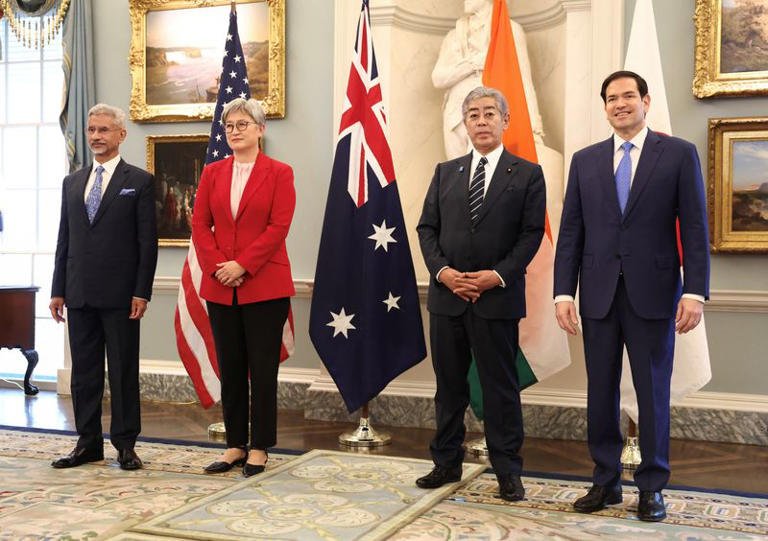
The four-nation alliance known as the Quad—comprising the United States, India, Japan, and Australia—has unveiled a new plan to secure and diversify critical mineral supply chains amid shared concerns over China’s increasing influence in the sector. While the partnership is seen as a strategic counterbalance to Beijing’s dominance, recent tensions stemming from U.S. tariff policies under President Donald Trump have complicated relations. The latest ministerial meeting in Washington aimed to strengthen economic security and regional cooperation, with a focus on delivering tangible outcomes.

I. Quad’s Economic Cooperation Strategy
1. Critical Minerals Initiative Takes Center Stage
Following high-level talks, the Quad foreign ministers announced the launch of the Quad Critical Minerals Initiative—an effort to enhance supply chain resilience by jointly investing in and securing access to essential materials. Described as an “ambitious expansion” of economic collaboration, the initiative underscores the Quad’s intent to mitigate vulnerabilities posed by China’s near-monopoly in the critical minerals market, which is crucial for technology, defense, and renewable energy sectors.


2. Economic Security Through Partnership
U.S. Secretary of State Marco Rubio welcomed his counterparts by reaffirming the importance of the Quad as a strategic alliance. He emphasized the need to move beyond dialogue and toward actionable solutions. To this end, 30 to 40 companies from Quad nations are expected to gather at the U.S. State Department to explore opportunities for cooperation and diversification in the critical minerals sector. This effort highlights a renewed focus on economic diplomacy in the Indo-Pacific.
II. Bilateral Engagements and Broader Goals
1. High-Level Diplomatic Interactions
Alongside the group discussions, Rubio held individual meetings with Indian Foreign Minister Subrahmanyam Jaishankar, Japanese Foreign Minister Takeshi Iwaya, and Australia’s Penny Wong. These one-on-one talks reinforced the alliance’s broader strategic alignment and helped address issues unique to each bilateral relationship. Wong later posted that the meeting signaled both the strength of the partnership and the urgency of shared global challenges.
2. A Platform for Regional Refocus
With growing instability in regions like the Middle East diverting U.S. attention, the meeting served as an opportunity to realign the Quad’s priorities toward Indo-Pacific stability. The members reaffirmed their commitment to meeting regularly and preparing for a leadership summit in India later this year, aiming to bolster regional cooperation in an increasingly complex geopolitical environment.

III. Trade Disputes and Ongoing Tensions
1. Trade Talks with India and Japan
Trade negotiations between the U.S. and India continue, with President Trump stating that a potential agreement could reduce tariffs and provide a level playing field for American companies. However, a separate trade deal with Japan appears less certain. A July 9 deadline for lifting levies looms, and Trump has expressed skepticism about finalizing terms with Tokyo.
2. Jaishankar Calls for Mutual Concessions
Speaking before the Quad gathering, Jaishankar expressed optimism about concluding trade talks with the U.S., while acknowledging the need for compromise from both sides. “It will take give and take to reach middle ground,” he remarked, signaling India’s willingness to engage constructively despite ongoing friction.
3. Disputes Over Defense Spending
Complicating matters further, Japan recently postponed a key annual ministerial meeting with U.S. officials. Reports suggest that Washington’s demands for increased Japanese defense spending contributed to the delay. Analysts noted a growing sense of frustration in Tokyo over what some view as aggressive public pressure from the Trump administration, threatening to undermine long-standing bilateral trust.
IV. Defense Collaboration and Regional Security
1. Strengthening U.S.-India Defense Ties
In a separate visit to the Pentagon, Jaishankar met with U.S. Defense Secretary Pete Hegseth, who emphasized the need to expand bilateral military cooperation. Hegseth voiced hopes of finalizing key arms deals and boosting co-production in the defense sector. These steps are part of a broader strategy to enhance interoperability and integrate India more deeply into the U.S.-led defense network in Asia.
2. Fallout from the Kashmir Conflict
Despite shared security interests, tensions between the U.S. and India have surfaced over how the two countries perceive recent developments in Kashmir. India rebuffed Trump’s claims that his intervention helped avert a full-blown war with Pakistan following the deadly April attack that killed 26 people. Jaishankar reiterated that India’s actions were independent of trade negotiations or foreign mediation, while noting that every bilateral relationship would inevitably face challenges.
3. Unified Condemnation of Terrorism
Despite disagreements, the Quad foreign ministers presented a united front in condemning the April 22 attack in Indian-administered Kashmir. The joint statement reaffirmed the group’s collective stance against terrorism and called for accountability. India continues to blame Pakistan for the attack—an allegation Pakistan denies—while the ceasefire that followed on May 10 helped calm tensions between the two nuclear-armed neighbors.
V. Broader Strategic Implications
1. A Strained Yet Strategic Alliance
While the Quad remains a vital forum for regional stability and cooperation, internal pressures threaten to hinder progress. Issues like tariff disagreements, defense spending disputes, and conflicting interpretations of recent geopolitical crises reflect the complexities of managing a diverse multilateral alliance.
2. Australia and the AUKUS Factor
Australian anxiety over recent U.S. moves—including a Pentagon-led review of the AUKUS submarine deal—adds another layer of tension. Elbridge Colby, a top U.S. defense official, is reportedly leading the effort, prompting concerns in Canberra about the future of the agreement. Australia’s participation in both AUKUS and the Quad reflects its deep investment in regional security but also places it in the middle of shifting U.S. priorities.
3. Keeping the Focus on the Indo-Pacific
The Washington-based Center for Strategic and International Studies warned that U.S. ties with Japan and other Quad members could lose momentum if Washington’s focus continues to drift. Analyst Nicholas Szechenyi pointed out that the administration’s preoccupation with tariff negotiations and defense demands risks alienating allies who view the Indo-Pacific as their primary security concern.
Conclusion
The latest Quad ministerial meeting marked a significant step toward deepening cooperation on critical minerals, economic resilience, and regional security. However, ongoing trade disputes, diverging national interests, and tensions over defense spending reveal the underlying complexities of the partnership. While the alliance remains strategically valuable, its long-term success depends on maintaining unity, respecting mutual concerns, and delivering on shared goals. In a world increasingly shaped by great power competition and shifting alliances, the Quad must evolve from a diplomatic forum into a platform for concrete action and trust-based collaboration.








