






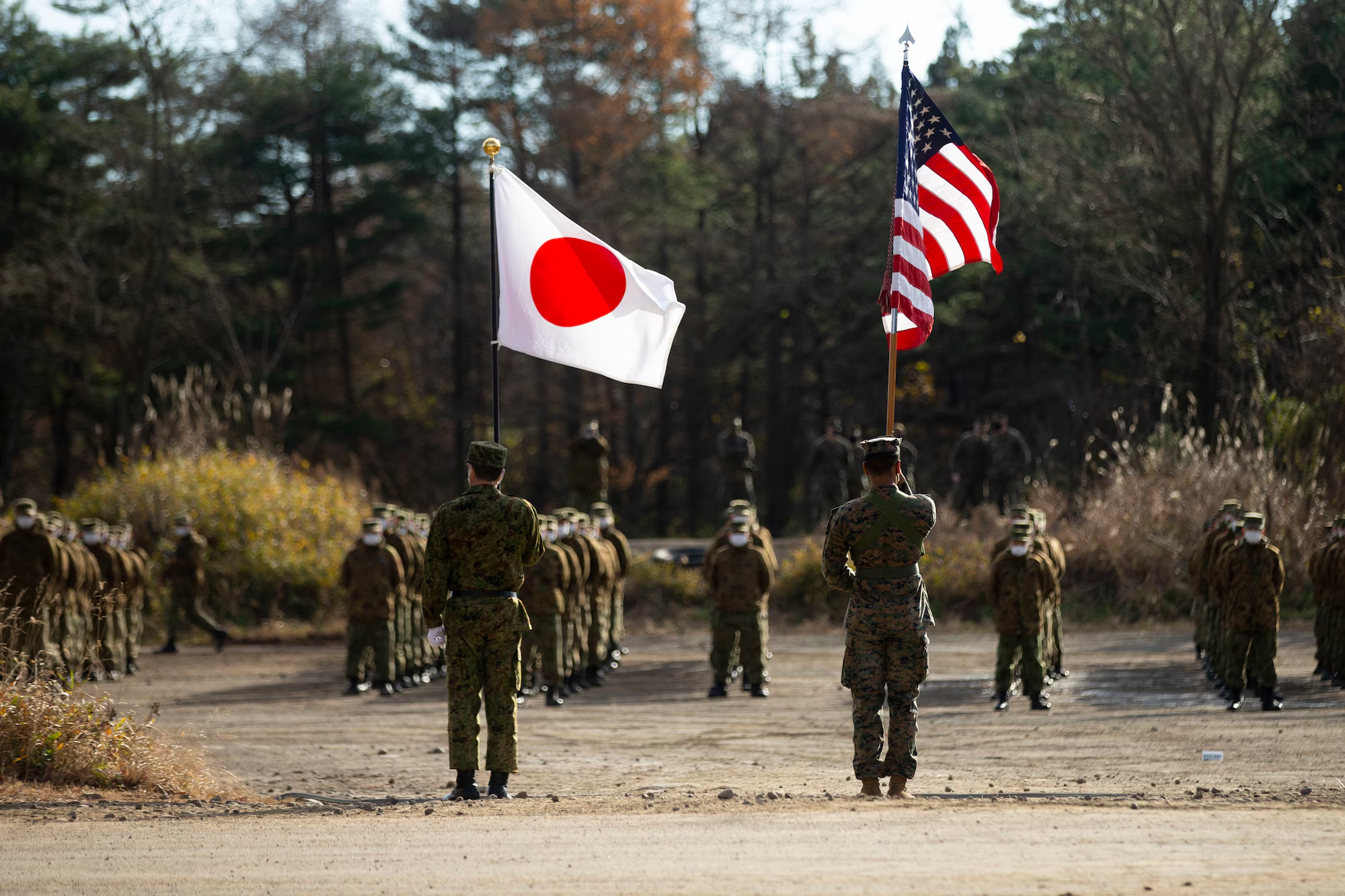


In recent years, Japan has taken bold steps to redefine its defense posture and expand its military role, marking a significant shift from its post-World War II pacifist identity. Long known for its constitutionally enshrined limitations on the use of force, Japan now finds itself in a rapidly evolving security environment shaped by intensifying regional tensions, particularly from China, North Korea, and Russia. These developments have pushed Tokyo to reassess its strategic priorities and engage in unprecedented military reforms.


This transformation is not merely a reaction to external threats, but a calculated, long-term effort by Japan to secure its sovereignty, bolster alliances, and assert itself as a proactive player in regional and global security. This article explores the underlying factors, strategic goals, and broader implications of Japan’s military expansion amid growing regional tensions.
The Pacifist Constitution and Its Constraints
Japan’s postwar military stance has been shaped by its 1947 Constitution, especially Article 9, which renounces war and prohibits the use of force to settle international disputes. The Japanese Self-Defense Forces (JSDF), established in 1954, have long been limited to defensive roles and constrained in scope, budget, and international engagement.
While the JSDF is among the world’s most technologically advanced and well-funded forces, it has historically operated under tight restrictions. Overseas deployments were rare and often focused on non-combat roles such as humanitarian aid and peacekeeping. Public sentiment also leaned strongly toward pacifism, shaped by the trauma of war and the nuclear bombings of Hiroshima and Nagasaki.
However, evolving threats and regional instability have led to a gradual reexamination of these constraints. Successive governments, especially under former Prime Minister Shinzo Abe, began pushing the boundaries of constitutional interpretation, leading to incremental but significant changes in Japan’s security policies.
China’s Rise and Maritime Assertiveness
Perhaps the most pressing reason for Japan’s military expansion is China’s growing power and assertiveness, particularly in maritime domains. China’s rapid military modernization, naval expansion, and increasing presence in the East and South China Seas have alarmed Tokyo.
The Senkaku Islands (known as Diaoyu in China), administered by Japan but claimed by Beijing, remain a flashpoint. Chinese coast guard ships and aircraft have regularly entered the surrounding waters and airspace, prompting Japan to scramble jets and reinforce maritime patrols. While no open conflict has erupted, the steady frequency of these encounters raises the risk of accidental escalation.
Moreover, China’s broader Indo-Pacific strategy, including the Belt and Road Initiative and fortified artificial islands in the South China Sea, is viewed by Japan as part of a long-term strategy to reshape regional power dynamics. As a key US ally and stakeholder in a free and open Indo-Pacific, Japan sees China’s moves as a direct challenge to international norms and regional stability.
North Korea’s Nuclear Threat and Missile Tests
North Korea’s continued missile testing and nuclear ambitions pose another grave concern for Japan. Pyongyang has launched multiple ballistic missiles over Japan’s airspace and into its exclusive economic zone (EEZ), defying UN resolutions and demonstrating an increasing capability to strike Japan or its allies.
The unpredictability of North Korea’s regime, combined with its advancing weapons technology, has prompted Tokyo to strengthen missile defenses, improve early warning systems, and consider counterstrike capabilities. The concept of acquiring “enemy base strike capability” — once considered taboo — is now part of Japan’s strategic discussions.
Japan has also enhanced its coordination with the US and South Korea through intelligence sharing, joint exercises, and trilateral diplomacy. However, the urgency of the North Korean threat has led Japan to accelerate its own defense initiatives rather than rely solely on external security guarantees.
Russia’s Military Activities in Northeast Asia
While often overshadowed by China and North Korea, Russia’s presence in the region also factors into Japan’s security calculus. Since the Ukraine invasion in 2022, Japan has taken a tougher stance against Moscow, joining Western sanctions and freezing Russian assets.
In retaliation, Russia has increased military activities near Japan, including joint naval patrols with China, and fortified the disputed Kuril Islands (referred to as the Northern Territories in Japan). These developments underscore the complexity of Japan’s strategic environment, surrounded by nuclear-armed neighbors and rising authoritarian powers.
Japan’s defense white papers now describe Russia as a “security concern,” highlighting a marked departure from past diplomatic ambiguity. Tokyo’s pivot reflects a broader recognition that peace cannot be preserved by pacifism alone in an era of resurgent militarism.
A Shift in Domestic Politics and Public Opinion
Domestic political shifts have played a pivotal role in enabling Japan’s military transformation. Under the leadership of Shinzo Abe and now Prime Minister Fumio Kishida, the ruling Liberal Democratic Party (LDP) has championed defense reforms, increased spending, and sought reinterpretation of constitutional constraints.
The 2015 Legislation for Peace and Security was a landmark moment, allowing Japan to engage in collective self-defense—defending allies under attack even if Japan is not directly targeted. This move, while controversial, laid the legal foundation for deeper military cooperation with the US and other partners.
Public opinion, traditionally resistant to military expansion, has also evolved. Surveys show growing support for a stronger defense posture, particularly in the face of Chinese aggression and North Korean threats. The Russian invasion of Ukraine further galvanized public and political will, demonstrating the dangers of unpreparedness.
Record-High Defense Spending and New Capabilities
In December 2022, Japan unveiled its largest-ever defense budget, pledging to double defense spending to 2% of GDP by 2027 — in line with NATO standards. This historic decision will make Japan the third-largest defense spender in the world, behind the US and China.
The spending surge is earmarked for enhancing capabilities in five key areas:
-
Missile and Counterstrike Capability
Japan plans to acquire long-range missiles, including US-made Tomahawks and indigenous systems, allowing it to strike enemy bases if attacked. This is a major departure from its traditional passive-defense posture. -
Cyber and Space Defense
Investments in cyber resilience, satellite surveillance, and space security aim to prepare Japan for future warfare domains. -
Integrated Air and Missile Defense
Japan is upgrading radar systems and interceptors to counter missile threats, particularly from North Korea. -
Unmanned Systems and AI
The JSDF will incorporate drones and AI-driven systems to enhance surveillance and operational effectiveness. -
Defense Industry Revitalization
Efforts are underway to strengthen domestic defense manufacturing and reduce dependence on foreign suppliers.
Deepening the US-Japan Alliance
At the heart of Japan’s strategic calculus is its alliance with the United States, a cornerstone of its postwar security. The US maintains roughly 50,000 troops in Japan, including a significant naval presence in Okinawa.
The alliance has matured into a comprehensive partnership encompassing missile defense, cyber cooperation, and joint military exercises. Japan’s expanded military role is seen by Washington as a positive development, easing the burden on US forces in the Indo-Pacific and contributing to regional deterrence.
In January 2023, the two countries agreed to modernize the alliance further, with the US supporting Japan’s counterstrike capabilities and integrated defense networks. The Quad grouping — comprising the US, Japan, India, and Australia — also reflects Japan’s growing role in shaping regional security architecture.
Multilateral Engagement and Strategic Partnerships
Beyond the US, Japan has actively pursued partnerships with other regional powers. It has strengthened security ties with Australia, India, the UK, and Southeast Asian nations, engaging in joint exercises, intelligence sharing, and capacity-building.
Japan’s involvement in the Quad, its Indo-Pacific strategy, and its outreach to NATO and the EU underscore its efforts to build a coalition of like-minded nations against coercive behavior by authoritarian states.
Moreover, Japan’s role in upholding freedom of navigation, international law, and rules-based order has earned it diplomatic goodwill, especially among smaller countries concerned about Chinese dominance.
Implications for Regional Security and Diplomacy
Japan’s military expansion is viewed with mixed reactions across the region. While allies like the US and Australia welcome it as a stabilizing force, countries like China and North Korea see it as a threat. Beijing has accused Japan of “military revivalism,” while Pyongyang has warned of retaliatory measures.
South Korea, historically wary of Japanese militarism due to colonial history, has recently softened its stance. Shared concerns over North Korea and China have prompted Seoul and Tokyo to mend ties, enhance trilateral cooperation with the US, and engage in joint defense initiatives.
Still, Japan must tread carefully. While strengthening deterrence, it must also invest in diplomacy, crisis communication, and regional engagement to prevent misunderstandings and arms races.
Conclusion: A New Era in Japan’s Security Policy
Japan’s military transformation marks the end of an era defined by strict pacifism and the beginning of a new strategic posture grounded in realism. Driven by external threats, domestic political will, and alliance expectations, Tokyo is reshaping its defense architecture to navigate a more dangerous and uncertain world.
This shift does not represent a rejection of Japan’s peaceful principles, but a pragmatic adaptation to geopolitical realities. By enhancing its military capabilities, Japan aims to deter aggression, protect its interests, and contribute more meaningfully to regional and global stability.
As Japan steps into this new era, it will need to balance power with prudence, strength with diplomacy, and history with future security imperatives. The coming years will test Japan’s resolve, but also offer an opportunity for it to emerge as a mature, responsible leader in shaping the Indo-Pacific order.