





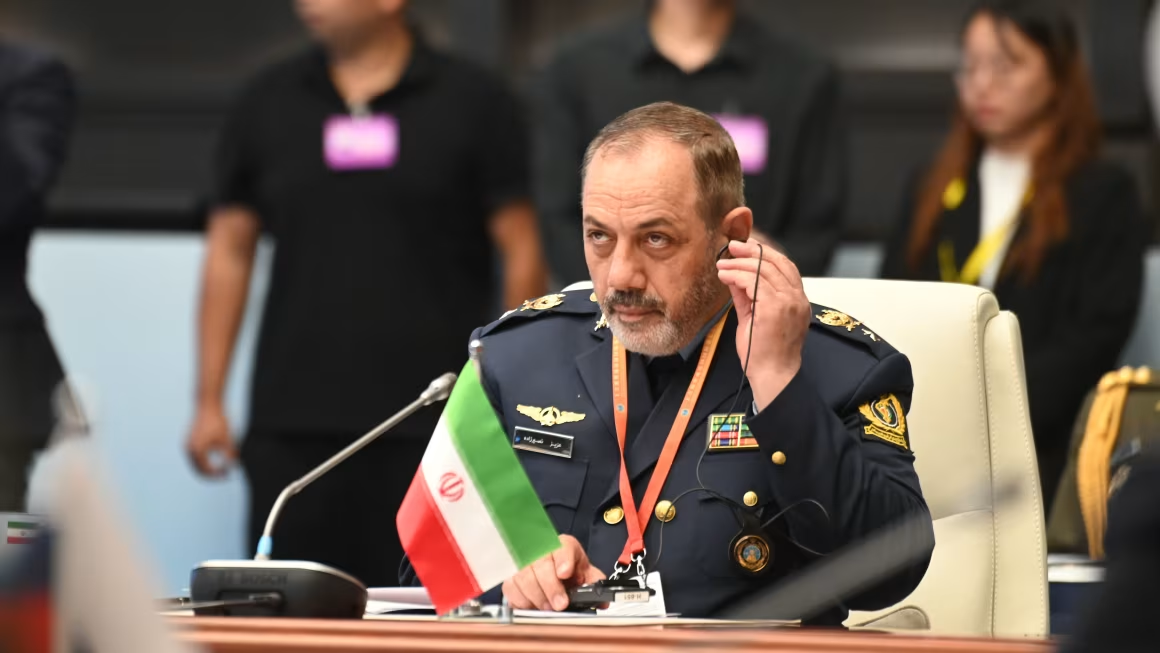


Amid shifting global alliances and heightened regional tensions, Iran’s Defense Minister Aziz Nasirzadeh recently visited China to attend a high-level meeting of the Shanghai Cooperation Organization (SCO). This marks his first international engagement following a 12-day conflict with Israel that briefly involved the United States. The visit underlines Tehran’s increasing reliance on China as a strategic diplomatic and economic partner while also highlighting Beijing’s ambitions to offer an alternative to U.S.-led global systems.

I. Strategic Engagements in Qingdao
1. Nasirzadeh’s First Foreign Mission Post-Conflict
Iranian Defense Minister Aziz Nasirzadeh was among nine defense leaders who gathered in Qingdao, China, for the SCO defense summit. His presence signals Iran’s intention to strengthen ties within multilateral blocs not aligned with the West, particularly following the recent violent exchange with Israel that included a U.S. airstrike on Iranian nuclear facilities.

2. The SCO: A Rising Multilateral Force
The Shanghai Cooperation Organization, originally formed in 2001 by China, Russia, and four Central Asian nations, now includes a broader array of countries such as Iran, India, and Belarus. Its growing influence mirrors the strategic vision of its leading members to establish new international mechanisms that challenge the dominance of U.S.-led institutions like NATO.
II. China’s Diplomatic Posture
1. A Platform for Alternative Global Governance
Chinese Defense Minister Dong Jun, while not directly addressing the Iran-Israel conflict, used his remarks to call out “hegemonic” behavior, language often used by Beijing to criticize Washington. He called on SCO members to enhance cooperation, defend fairness, and contribute to global strategic stability.
2. Iran’s Praise for Chinese Support
During the summit, Nasirzadeh thanked China for backing Iran’s “legitimate stance” and expressed hope that Beijing would continue to act as a stabilizing force in the region. His remarks reflect Tehran’s desire for China to play a more assertive role in easing tensions following the Israel-Iran clash.
III. Reactions and Regional Implications
1. China’s Criticism of U.S. and Israeli Actions
Beijing condemned Israel’s June 13 airstrike that killed key Iranian military leaders, as well as the subsequent U.S. intervention. Chinese officials labeled the events a threat to the global nuclear non-proliferation regime and called for a ceasefire, reinforcing China’s narrative as a responsible global actor amid Western aggression.
2. Iran-China Military and Economic Collaboration
China continues to be Iran’s largest energy customer and a crucial economic lifeline, particularly under U.S. sanctions. The two nations have enhanced military cooperation through joint naval exercises and strategic agreements, with recent reports indicating shipments of Chinese chemical precursors for missile fuel to Iran.
3. A Calculated Diplomatic Approach
While backing Iran diplomatically, Beijing has avoided deeper military involvement in the conflict. At a press briefing, Chinese Defense Ministry spokesperson Zhang Xiaogang emphasized China’s commitment to regional peace and stability, sidestepping direct questions about material support to Iran.
IV. SCO’s Growing but Fractured Influence
1. Expanding Membership, Diverging Interests
The SCO’s expansion includes diverse member states with overlapping, and at times conflicting, interests. While its mission focuses on combating terrorism and maintaining regional stability, internal disputes—such as those between India and Pakistan or China and India—limit its cohesion.
2. Lack of Consensus on Key Issues
Despite hosting significant players, the Qingdao summit failed to produce a joint statement. According to India’s foreign ministry, disagreements over language concerning “terrorism” prevented consensus, revealing internal rifts that may hinder the SCO’s ability to act as a unified bloc.
3. Symbolism Over Substance?
Though not a formal military alliance, the SCO presents itself as a stabilizing force in Eurasia. However, critics argue that its influence remains largely symbolic due to underlying geopolitical frictions and the absence of enforceable frameworks.
Conclusion
Iran’s participation in the SCO summit hosted by China signifies a strategic pivot towards alternative international alliances as tensions with the West escalate. For China, the event reinforces its vision of reshaping global order through multilateralism and reduced dependence on Western structures. Yet, internal divisions within the SCO suggest that while the bloc may serve as a counterbalance to Western influence, its effectiveness in resolving complex geopolitical challenges remains uncertain.








