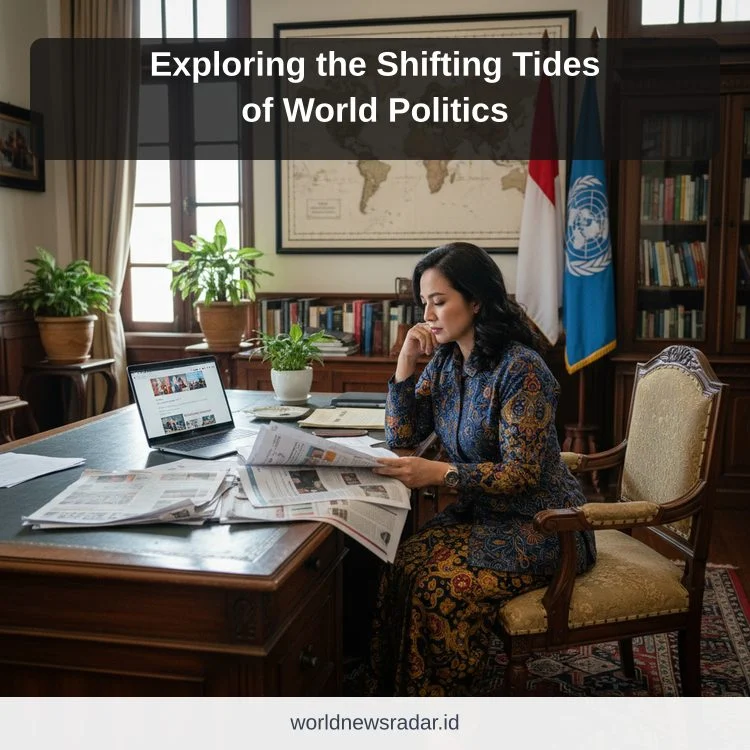




In an increasingly interconnected yet fractured world, understanding the intricate dance of international relations has never been more crucial. From the halls of power in Washington D.C. to the bustling markets of Beijing, the currents of global influence are constantly shifting, impacting everything from economic stability to social cohesion. This deep dive into world news explores the complex web of political forces, ideological battles, and power struggles that define our era. We’ll dissect the major trends reshaping international diplomacy, examine the rise of new geopolitical players, and analyze the profound implications for societies worldwide. As journalists and analysts at worldnewsradar.id, we aim to provide a comprehensive and nuanced perspective on these critical developments, offering insights into the forces that are charting the course of our future. Keeping abreast with these daily developments, much like following a global newspaper or a broad broadcast from a renowned source like BBC News, is essential for every informed citizen.


The Resurgence of Great Power Competition
One of the most defining characteristics of contemporary world news is the unambiguous return of great power competition. For decades following the Cold War, a unipolar world order dominated, characterized by American hegemony. Today, however, we see a multipolar landscape emerging, with China’s economic and military ascent challenging the established order, and Russia asserting its influence more aggressively on the global stage. This resurgence isn’t merely about military capabilities; it encompasses economic leverage, technological dominance, and ideological leadership. For example, the ongoing trade disputes between the United States and China, coupled with Beijing’s Belt and Road Initiative, illustrate the economic front of this competition. Similarly, Russia’s actions in Ukraine and its engagement in the Middle East demonstrate a willingness to challenge Western interests. These dynamics create a more volatile and unpredictable international environment, where alliances are fluid, and strategic calculations are constantly being recalibrated by nations big and small. The implications for geopolitical stability are profound, necessitating a constant, vigilant watch on the daily news from all corners of the globe.

The strategic implications of this competition are vast. Nations are increasingly aligning themselves based on economic and security interests, leading to the formation of new blocs and the re-evaluation of existing treaties. The Indo-Pacific region, for instance, has become a hotbed of strategic maneuvering, with alliances like the Quad (Quadrilateral Security Dialogue) forming to counter perceived threats. Simultaneously, countries are investing heavily in defense and cyber capabilities, reflecting a growing sense of insecurity and the need to protect national interests in an increasingly digitized battlefield. This complex interplay of forces demands careful analysis from every major online news outlet. Furthermore, the competition extends into the realm of soft power, with nations vying to promote their values, cultures, and governance models as superior alternatives. This ideological contest is often fought through misinformation campaigns and digital propaganda, making it harder for individuals to discern accurate information and form informed opinions. Understanding these multifaceted dimensions is crucial for any observer of global politics, as the decisions made by these great powers directly impact global stability and prosperity.
Technological Disruption and Geopolitical Fault Lines
Technology has always been a driver of human progress, but in the 21st century, its disruptive power has taken on unprecedented geopolitical significance, fundamentally reshaping the landscape of world news. Artificial intelligence, quantum computing, 5G networks, and biotechnology are not just scientific marvels; they are strategic assets that nations are scrambling to control and master. The race for technological supremacy has become a new front in great power competition, with countries like the United States and China engaging in frantic efforts to lead in these innovative sectors. This competition is not purely economic; it has profound national security implications. For example, control over 5G infrastructure is seen by some as vital for future intelligence gathering and military capabilities, leading to bans and restrictions on certain companies. Intellectual property theft and cyber warfare have also become pervasive threats, with state-sponsored actors targeting critical infrastructure and sensitive data, as frequently reported by outlets like BBC News.
The digital revolution has also created new geopolitical fault lines. The internet, once hailed as a tool for democratization, is increasingly being weaponized by authoritarian regimes for surveillance and censorship. “Digital sovereignty” has become a buzzword, as nations seek to control information flows within their borders and reduce reliance on foreign technology providers. This fragmentation of the global internet, often referred to as a “splinternet,” has significant implications for global communication, trade, and even human rights. The development of advanced surveillance technologies, such as facial recognition and predictive policing, raises serious ethical concerns and has been deployed by some governments to suppress dissent. Moreover, the concentration of technological power in a few global corporations, many of them based in the US or China, creates new forms of influence and control that transcend traditional state boundaries. Navigating this complex interplay of technology and geopolitics requires a deep understanding of both, and continuous monitoring of online news platforms.
The Evolving Nature of Alliances and Multilateralism
The traditional pillars of international relations, alliances, and multilateral institutions, are undergoing significant transformations in response to the shifting global order, a topic frequently covered in world news analyses. Post-World War II, institutions like the United Nations, NATO, and the World Trade Organization formed the bedrock of global governance, promoting cooperation and stability. However, in recent years, these institutions have faced unprecedented challenges, from internal divisions to external pressures. The rise of nationalism and protectionist policies in several key nations has strained multilateral cooperation, leading to questions about the relevance and effectiveness of these bodies. The withdrawal of the United States from international agreements, even if temporary, and the lukewarm engagement of some other major powers have weakened their collective efficacy, making informed daily news consumption vital.
At the same time, we are witnessing the emergence of new, more flexible forms of alliances and partnerships, often formed to address specific regional or thematic challenges. The Quad, mentioned earlier, is one such example, focusing on Indo-Pacific security. Other ad-hoc coalitions are forming around issues like climate change or cybersecurity, bringing together a diverse group of state and non-state actors. This phenomenon, sometimes dubbed “minilateralism,” suggests a move away from rigid, treaty-bound structures towards more agile and issue-specific cooperation. However, while these new frameworks offer flexibility, they also raise concerns about fragmentation and a lack of broader global coordination. The competition between traditional multilateralism and these newer, more agile forms of cooperation will continue to shape global governance in the coming decades, demanding a careful watch on every report from a reliable newspaper or online news source.
Climate Change and Resource Scarcity as Geopolitical Drivers
Beyond traditional political and economic rivalries, climate change and resource scarcity are increasingly becoming potent geopolitical drivers, frequently dominating world news headlines. The scientific consensus is clear: a warming planet will lead to more extreme weather events, rising sea levels, and disruptions to ecosystems, all of which have profound implications for human societies and international stability. These environmental challenges are not just humanitarian concerns; they are security threats. For instance, water scarcity in politically unstable regions can exacerbate existing conflicts, leading to mass displacement and humanitarian crises. The scramble for dwindling resources, whether it be fresh water, arable land, or rare earth minerals critical for technology, can spark new rivalries and militarize previously peaceful borders, as often highlighted by BBC News reporting.
The concept of “climate refugees” is becoming a stark reality, as millions are forced to leave their homes due to droughts, floods, and desertification. This mass migration can place immense strain on host countries, leading to social unrest and political instability. Furthermore, the global transition to renewable energy, while necessary, also creates new geopolitical dependencies and vulnerabilities. The control over critical minerals required for batteries and solar panels, for example, is becoming a new point of contention between nations. How countries adapt to and mitigate the effects of climate change, and how they manage increasingly scarce resources, will undoubtedly shape their foreign policies and international relationships for decades to come. Monitoring these environmental and resource-related developments in the daily news is crucial for understanding the full spectrum of geopolitical challenges.
The Enduring Power of Ideology and Identity Politics
While economic and strategic interests often drive international relations, the enduring power of ideology and identity politics continues to play a significant role in shaping global events and influencing world news narratives. The 21st century has witnessed a resurgence of nationalism, populism, and various forms of identity-based movements, often fueled by economic grievances, cultural anxieties, and a backlash against globalization. These internal political dynamics frequently spill over into the international arena, influencing foreign policy decisions and shaping alliances. For example, the rise of populist leaders in various countries has led to more protectionist trade policies and a greater emphasis on national sovereignty, sometimes at the expense of international cooperation, a trend frequently analyzed by every reputable newspaper.
Ideological battles are also playing out on a global scale. The competition between democratic and authoritarian models of governance, for instance, is not just theoretical; it manifests in diplomatic clashes, human rights debates, and proxy conflicts. The struggle for influence often involves promoting a particular ideological worldview, whether it’s liberal democracy, state capitalism, or religious fundamentalism. Social media and digital platforms have amplified these ideological contests, allowing ideas to spread rapidly across borders and mobilize populations. Understanding these underlying ideological currents and the role of identity in shaping national and international behavior is critical for interpreting the complex tapestry of global politics. For instance, the ongoing debates about universal human rights versus cultural relativism reflect deep ideological divides that consistently make headlines in online news.
Examining the Role of Non-State Actors and Global Governance in a Fragmented World
While states remain the primary actors in international relations, the influence of non-state actors has grown exponentially, often presenting new challenges and opportunities for global governance, a topic repeatedly analyzed in world news. Transnational corporations, international non-governmental organizations (NGOs), terrorist groups, and even powerful individuals now wield significant influence on the global stage. For example, multinational corporations can dictate economic policies in smaller states, while NGOs like Médecins Sans Frontières or Amnesty International play crucial roles in humanitarian aid and human rights advocacy, often shaping public opinion through their reports in online news. Conversely, terrorist organizations like ISIS or Al-Qaeda demonstrate the destructive power of non-state actors to destabilize entire regions and challenge national security. This complex interplay between state and non-state actors complicates traditional notions of sovereignty and governance.
The rise of these non-state actors, coupled with the challenges to established multilateral institutions, paints a picture of a fragmented world governance landscape. Issues like climate change, global pandemics, and cybercrime are inherently transnational and cannot be effectively addressed by individual states alone. They require coordinated international responses, yet the mechanisms for such cooperation are often strained. The COVID-19 pandemic, for instance, starkly highlighted both the urgency of global collaboration and the difficulties in achieving it due to nationalistic tendencies and vaccine nationalism, as extensively covered by BBC News and other major outlets. Therefore, understanding how these diverse actors interact and how new forms of global governance, both formal and informal, are emerging is crucial. The future of global stability hinges on the ability of nations and non-state entities to forge effective partnerships and address shared challenges in an increasingly complex and interconnected world, a constant subject of scrutiny in the daily news.
Kesimpulan
The landscape of world news is characterized by an intricate and ever-evolving array of forces, making it a critical time for informed engagement. From the resurgence of great power competition and the disruptive impact of technology to the existential threats posed by climate change, and the enduring influence of ideology and identity politics, the currents shaping our global future are profound and multifaceted. As major online news providers and analysts, we at worldnewsradar.id are committed to dissecting these complex dynamics, offering our readers a clear and insightful perspective on the global shifts that impact every facet of life. Staying informed through reliable sources, much like perusing a well-regarded newspaper or following the updates from trusted broadcasters like BBC News, is not merely an academic exercise; it is an imperative for navigating an increasingly complex world. Understanding these tides ultimately empowers us to better comprehend the challenges and opportunities that lie ahead, fostering a more informed and engaged global citizenry. We urge you to continue following our extensive coverage to stay ahead of these crucial global developments.