





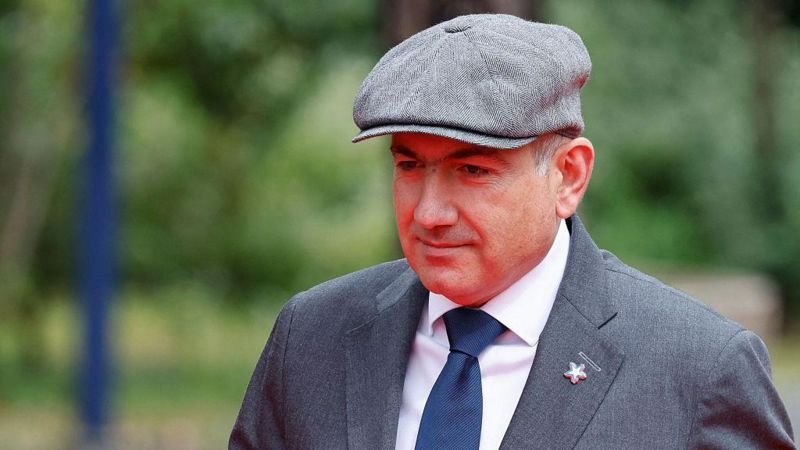


Armenia is currently engulfed in a deepening political and religious crisis, following an extraordinary series of events that have shaken the nation’s leadership, religious authority, and civil society. Prime Minister Nikol Pashinyan finds himself locked in a bitter standoff with the Armenian Apostolic Church, sparking mass arrests, coup accusations, and shocking public statements.

The tension reached a surreal point earlier this week when Pashinyan offered to expose himself on Facebook to prove he had not been circumcised—an attempt to counter allegations questioning his Christian faith.
This bizarre statement marked a new low in what many now describe as a crisis of governance, one that blends politics, religion, personal scandal, and accusations of foreign influence.
I. The Origins of the Armenia Church-State Conflict
1. A Velvet Revolution’s Legacy Under Strain
Pashinyan rose to power in 2018 following Armenia’s Velvet Revolution, a peaceful uprising against entrenched political elites. Since then, he has relied heavily on social media to communicate directly with the public, bypassing traditional media and institutions.
However, since Armenia’s defeat in the 2020 Nagorno-Karabakh war with Azerbaijan, public confidence in Pashinyan has declined, and the Church has emerged as a vocal critic of his administration.
2. Circumcision Allegation Triggers Outrage
The latest confrontation erupted after Father Zareh Ashuryan, a priest from Masis, accused Pashinyan of being circumcised—suggesting he had abandoned Christian tradition. In response, the prime minister declared on Facebook that he would expose himself to Church leaders to prove otherwise.
Though absurd on the surface, the incident reflects growing hostility between Armenia’s secular government and its dominant religious institution, the Armenian Apostolic Church.
II. Accusations Against the Catholicos
In late May, Pashinyan escalated the conflict by accusing Catholicos Karekin II, the head of the Armenian Church, of breaking his vow of celibacy and fathering a child—a direct assault on the spiritual leader’s credibility.
The Church declined to respond to the personal accusation but condemned Pashinyan for undermining Armenia’s spiritual unity. In response, state-affiliated media circulated images and personal details of Karekin II’s alleged daughter.
Adding fuel to the fire, Pashinyan’s government established a “co-ordination group” aimed at organizing the election of a new Church leader—despite Armenia’s constitutional provision for the separation of Church and state.
When the Catholicos returned from the UAE, hundreds of supporters met him at Yerevan airport, chanting his name in a show of defiance.
3. Coup Plot Allegations and Mass Arrests
1. Archbishop and Opposition Figures Detained
Tensions reached a breaking point when 16 individuals, including Archbishop Bagrat Galstanyan, were arrested for allegedly plotting a coup.
Galstanyan, who leads the Sacred Struggle opposition movement and spearheaded mass protests in 2023, now faces charges of terrorism and an attempt to overthrow the government. A court has ordered him into two months of pre-trial detention.
Also detained were a former MP, an opposition figure, a businessman, and a political blogger. Government investigators claim the group planned to form 250 armed groups, each consisting of 25 members, to orchestrate nationwide chaos and seize control of the state.
Critics, including Galstanyan’s lawyers, have dismissed the charges as politically motivated, branding them a tactic to silence dissent.
2. Leaked Coup Plans and Political Fallout
Government-friendly media later published what they claimed was a detailed coup plot involving Galstanyan, the Church, Russian-Armenian billionaire Samvel Karapetyan, and former presidents Robert Kocharyan and Serzh Sargsyan.
Pashinyan mocked the alleged conspirators on social media, sharing their photos and declaring it a “failed revolution of crooks.” Sargsyan’s Republican Party responded by accusing the government of weaponizing law enforcement to stifle opposition voices.
III. The Arrest of Billionaire Samvel Karapetyan
1. Prominent Church Supporter Detained
One of the most explosive developments came with the arrest of Samvel Karapetyan, a billionaire with dual Russian and Armenian citizenship. Karapetyan, known for his company Tashir Group—which owns real estate, energy companies, and a popular pizza brand across Russia—was a major benefactor of the Armenian Church.
In a video released before his arrest, Karapetyan pledged unwavering support for the Church and warned that if politicians failed, “we will intervene.”
Hours later, Armenian law enforcement raided his mansion and charged him with publicly inciting a seizure of power. He denies all charges.
2. Government Moves to Nationalize Karapetyan’s Assets
Following his arrest, Pashinyan announced his government’s intention to nationalize the Electric Networks of Armenia (ENA), which is owned by Karapetyan. Speaking at a cabinet meeting, Pashinyan emphasized the urgency of reclaiming control over critical infrastructure. “We must do this swiftly and effectively,” he said, sparking speculation that the move is politically motivated rather than economically necessary.
3. Russian Reaction and International Repercussions
Karapetyan’s arrest also caused an uproar among the Armenian diaspora in Russia. Massive billboards supporting the billionaire appeared in Moscow, while the Russian Foreign Ministry expressed concern.
Spokeswoman Maria Zakharova stated that Moscow was closely monitoring the situation and would ensure that Karapetyan’s legal rights are respected, signaling growing tension between Yerevan and Moscow.
IV. Church and State at a Crossroads
1. A Test of Armenia’s Democracy
This crisis raises fundamental questions about freedom of religion, political opposition, and civil rights in Armenia. While Pashinyan claims to be defending secular democracy, critics argue that his actions resemble authoritarian overreach.
The conflict reveals how unresolved tensions between state institutions and religious authority can spiral into national unrest when compounded by personal attacks, mass arrests, and constitutional breaches.
2. International Concerns and Electoral Implications
With elections approaching in 2025, Pashinyan’s handling of the Church crisis, arrests of high-profile figures, and authoritarian rhetoric could become central themes in the campaign. International observers are also paying close attention, as Armenia balances its post-Soviet identity and growing geopolitical pressures from Russia and the West.
Conclusion: Armenia’s Future at Stake
What began as a feud between Armenia’s Prime Minister and the head of the Church has now spiraled into a constitutional crisis, national scandal, and potential international conflict. The arrest of political opponents, clerics, and billionaires under accusations of coup plotting paints a disturbing picture of political persecution masked as national security enforcement.
Pashinyan’s provocative social media rhetoric, combined with aggressive state tactics, reflects a leadership style increasingly defined by confrontation rather than consensus.
As Armenia faces pivotal elections, a battered Church, and scrutiny from both its people and global allies, the choices made in the coming months could determine the nation’s democratic credibility—and its future direction.








