





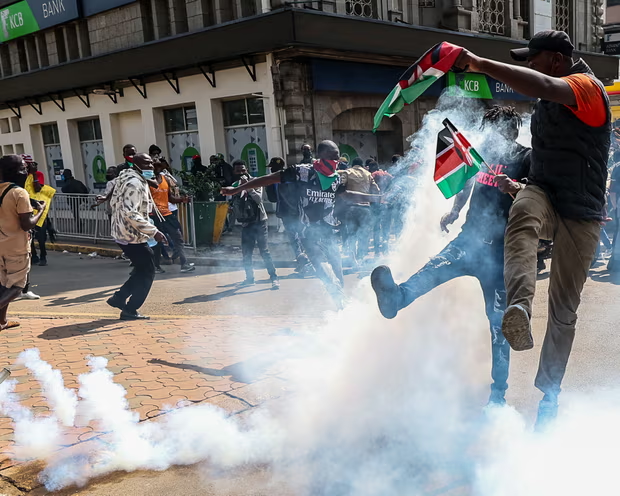


Nationwide demonstrations in Kenya turned violent on Wednesday, leaving at least 16 people dead and hundreds injured, according to official reports. The protest, initially organized to pay tribute to those killed in last year’s anti-government rallies, quickly escalated into confrontations between demonstrators and police. While the demonstrations began peacefully, honoring the memory of more than 60 victims from the 2023 protests, the scenes soon deteriorated, exposing deeper public discontent over corruption, rising living costs, and police brutality.

I. Rising Toll and Confirmed Casualties
1. Verified Deaths and Injuries
Amnesty International Kenya’s executive director, Irũngũ Houghton, confirmed that 16 fatalities had been verified by the government-backed Kenya National Commission on Human Rights. “Most of those who died were shot by police,” Houghton stated, emphasizing concerns over excessive force used by law enforcement. Additionally, a joint report from protest support organizations indicated 83 people suffered severe injuries, with at least eight treated for gunshot wounds.
2. Protesters Demand Accountability
The Law Society of Kenya (LSK), the Police Reforms Working Group, and the Kenya Medical Association jointly issued a statement calling for national dialogue to resolve the country’s growing political crisis. “We pray for our nation, dialogue, and a way forward,” the statement read. Faith Odhiambo, LSK’s president, further expressed frustration on social media, lamenting the vicious cycle of violence: “More lives are being lost as the people seek justice for those already lost.”
II. Widespread Demonstrations Across Cities
1. Mass Mobilization in Nairobi
In Nairobi, thousands of protesters poured into the streets despite heavy police presence. Officers erected barricades on roads leading to the city center, blocked access to key government buildings, and deployed razor wire around the State House and parliament. Many businesses remained shuttered as demonstrators marched with placards bearing photos of last year’s victims and chanted slogans opposing President William Ruto.
2. Violence and Media Blackout
As tensions mounted, police resorted to teargas, water cannons, and baton charges. In return, protesters threw stones and lit street fires. The unrest quickly spread to other cities, including Mombasa, Kisumu, and Nakuru, where similar clashes were reported. In Kikuyu town, Kiambu County, sections of court buildings were set on fire by demonstrators.
Meanwhile, the Communications Authority of Kenya instructed broadcasters to halt live protest coverage. Non-compliant networks—including NTV, KTN, K24, and Kameme—were temporarily taken off air, raising concerns over media censorship during a national crisis.
III. Public Anger Over Deepening Grievances
1. Years of Corruption and Economic Strain
The protests are rooted in widespread frustration over government mismanagement, entrenched corruption, and soaring unemployment. Public trust has eroded due to rising living costs and repeated fiscal burdens such as tax hikes, which were central to last year’s protest wave.
2. Police Brutality and Impunity
Adding fuel to the fire are two recent incidents that have galvanized public outrage. First was the death of schoolteacher Albert Ojwang while in police custody—allegedly for criticizing a high-ranking officer on social media. Days later, during a protest over Ojwang’s death, police shot and killed vendor Boniface Kariuki at close range.
These episodes have reignited fears of unchecked police violence and deepened resentment against the authorities. For many, they symbolize a broader trend of extrajudicial abuse that has continued with impunity.
IV. Voices from the Streets
1. Stephanie Marie: “It Could Be Anyone”
Among the thousands in Nairobi was Stephanie Marie, a young demonstrator who joined the march in memory of Ojwang. “It could be my brother, it could be my cousin,” she said. Her message to Kenya’s leaders was clear: “You’re here for the people. We just want you to listen.”
2. Innocent: “We’ve Come to Fight for Our Rights”
Another protester, who gave only the name Innocent, said he was marching to honor a friend killed in last year’s protests. Despite enduring multiple rounds of teargas, he remained undeterred. “The youth are unstoppable,” he declared. “We don’t want bad leadership.”
V. Political Stalemate and Institutional Concerns
1. Legislative Response and Escalation
The root of last year’s unrest lies in the controversial passage of legislation that raised taxes, passed even as citizens attempted to storm parliament in protest. Since then, while street demonstrations waned, incidents of targeted killings, enforced disappearances, and unlawful detentions have continued, further eroding faith in governance.
2. Calls for Reform and Mediation
Civic groups are calling on the Ruto administration to acknowledge public concerns and engage in meaningful reforms. However, with increasing control over media and suppression of dissent, questions remain about the government’s willingness to pursue dialogue and accountability.
Conclusion
Kenya finds itself in a state of deepening unrest as public anger continues to swell over governance failures, police brutality, and economic hardship. The nationwide protests, intended as a solemn tribute to last year’s victims, have now become a broader cry for justice and institutional change. As the death toll climbs and tensions escalate, the urgency for genuine dialogue and reform becomes undeniable. Voices from the streets are no longer just protesting past injustices—they are demanding a different future.








