




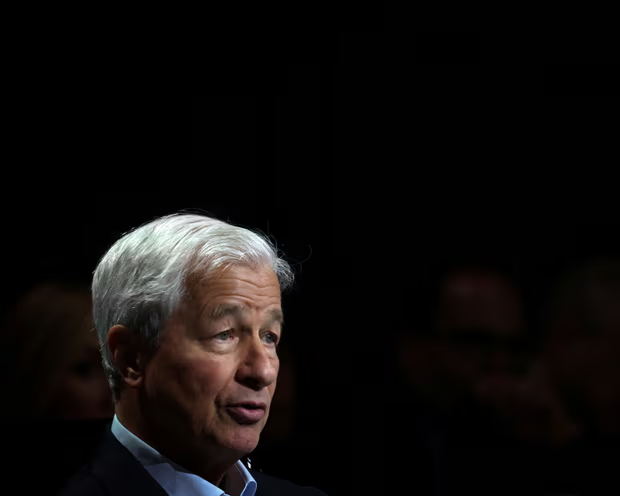

The financial world was rattled this week as Moody’s downgraded the United States’ credit rating, removing its final triple-A status among the three major agencies. Despite initial unease in the markets, stock prices stabilized by day’s end. However, JPMorgan Chase CEO Jamie Dimon voiced strong warnings about the broader implications of this downgrade, cautioning investors against underestimating the risks tied to America’s growing debt burden and the threat of stagflation.


I. Moody’s Downgrade and Market Reactions
1. Moody’s Delivers the Final Blow to U.S. Credit Rating
Moody’s downgrade of the United States from AAA to AA1 marks a symbolic but significant shift in global perceptions of U.S. fiscal stability. With this move, all three major credit agencies have now lowered the country’s top credit rating, citing persistent budget deficits and rising interest costs as key reasons.


In its statement, Moody’s expressed concern over the federal government’s inability to implement long-term fiscal reforms, saying, “We do not believe that material multi-year reductions in mandatory spending and deficits will result from current fiscal proposals under consideration.”

2. Markets React but Quickly Recover
The announcement prompted an early sell-off in U.S. equity markets on Monday. The S&P 500 fell during morning trading, while the Nasdaq also opened lower. However, both indexes managed to claw back losses by the close, with the S&P ending slightly in positive territory and the Nasdaq largely flat.
In Europe, London’s FTSE 100 recorded a modest 0.2% gain, demonstrating investor resilience in global markets despite concerns about U.S. fiscal health. Still, the bond market reflected investor caution—yields on 30-year U.S. Treasury bonds jumped 13 basis points to 5.026%, indicating a demand for higher returns amid growing uncertainty.

II. Jamie Dimon Sounds the Alarm
1. Warning Against Investor Complacency
During JPMorgan’s annual investor day in New York, CEO Jamie Dimon issued a stark message to Wall Street: the markets are dangerously underestimating the risks posed by the nation’s mounting fiscal imbalances. “We have huge deficits,” Dimon said. “We have what I consider almost complacent central banks. You all think they can manage all this. I don’t think [they can].”
He underscored what he called an “extraordinary amount of complacency” in the financial system and highlighted the growing possibility of stagflation—an economic scenario marked by stagnant growth combined with rising inflation—as a credible threat.
2. Rising Debt and Risk of Stagflation
Dimon’s remarks came amid mounting concern that the U.S. government is failing to address ballooning deficits and long-term spending obligations. His fear is that such imbalances, if left unchecked, could lead to sluggish growth, persistently high inflation, and ultimately damage the country’s creditworthiness even further.
His concerns were echoed by Moody’s, which forecast that “over the next decade, we expect larger deficits as entitlement spending rises while government revenue remains broadly flat.”
III. Political Challenges and Fiscal Paralysis
1. Trump’s Tax and Spending Plans Add to the Debt
The timing of the credit downgrade coincides with President Donald Trump’s efforts to pass a sweeping tax cut and spending package. Late Sunday night, House Republicans pushed the bill through a key committee, despite projections that it could add up to $5 trillion to the national debt over the next decade—already standing at $36.2 trillion.
Moody’s highlighted the chronic inability of U.S. lawmakers to implement meaningful fiscal reform across successive administrations. “Successive US administrations and Congress have failed to agree on measures to reverse the trend of large annual fiscal deficits and growing interest costs,” the agency stated.
2. Political Distractions and Public Response
Trump has not directly addressed the downgrade. Instead, he used his Truth Social platform on Monday to criticize high-profile celebrities like Beyoncé and Bruce Springsteen, who recently spoke out against him. His silence on such a pivotal economic issue raised further questions about the administration’s priorities.
Meanwhile, Treasury Secretary Scott Bessent attempted to downplay the downgrade’s significance, telling NBC’s Meet the Press that “Moody’s is a lagging indicator.” However, markets and analysts alike remain unconvinced that the government has a credible plan to rein in spending or reduce the deficit.
IV. Long-Term Outlook and Market Implications
1. Mounting Debt and Investor Confidence
The downgrade has cast fresh doubt on America’s long-term fiscal trajectory. As deficits are expected to persist and interest payments balloon, the U.S. may find it increasingly difficult to maintain investor confidence—especially if the global economy slows or if interest rates continue to rise.
Higher yields on government bonds already signal growing skepticism among investors. As bond prices fall and yields rise, the cost of servicing the national debt increases, putting even more pressure on government finances.
2. The Dollar and Global Comparisons
The dollar weakened against a basket of international currencies following the downgrade, reflecting a more cautious outlook from global investors. Moody’s warned that the U.S.’s fiscal condition is likely to worsen when compared to other high-rated nations.
As America’s fiscal performance continues to deteriorate, the risk grows that borrowing costs could rise further, undermining efforts to stimulate economic growth or manage inflation effectively.
Conclusion
The downgrade of the U.S. credit rating by Moody’s, the last of the major agencies to do so, has reignited long-standing concerns about the sustainability of federal deficits and the risk of future economic instability. While stock markets showed resilience in the immediate aftermath, bond yields and investor sentiment suggest deeper unease. Jamie Dimon’s stark warning against complacency is a reminder that without serious reforms, the U.S. risks entering an era defined by stagnant growth, high debt, and diminishing fiscal credibility. The political wrangling in Washington only adds to the uncertainty, leaving investors to weigh short-term market calm against long-term structural risks.








