





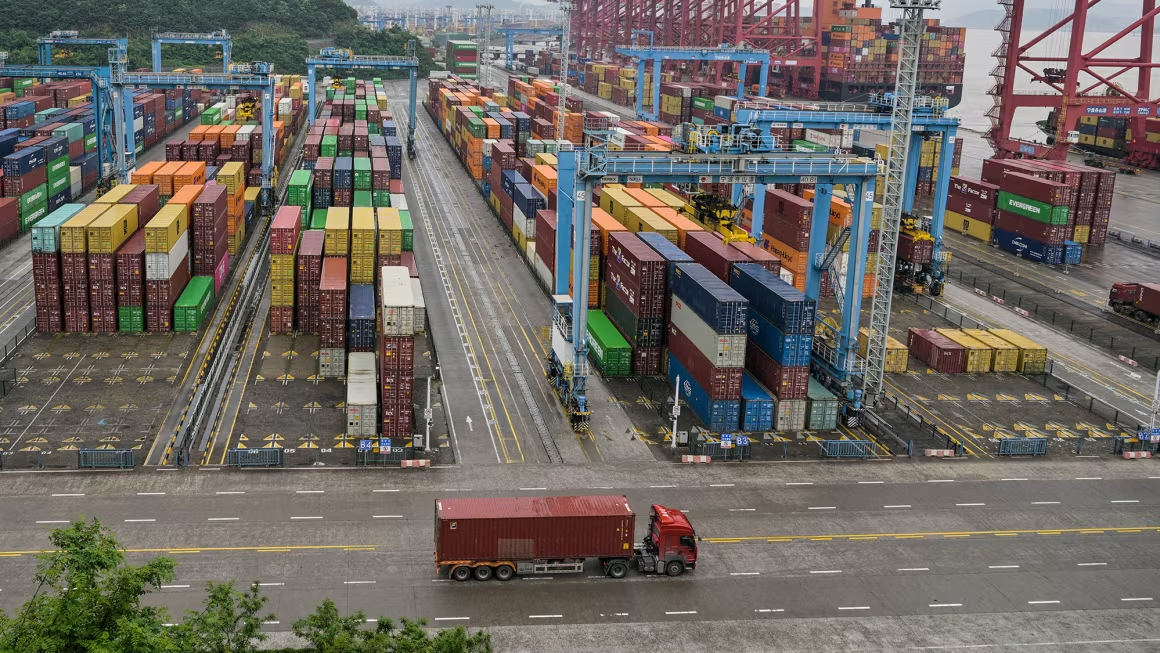


The world economy is now projected to experience its most sluggish decade of growth since the 1960s, driven in large part by escalating global trade tensions — particularly those stemming from U.S. tariff policy. According to a recent report by the World Bank, President Donald Trump’s aggressive trade measures are causing uncertainty and disruption across economies worldwide, undermining confidence and long-term planning. The forecast signals a concerning trend for both developed and emerging markets as governments, investors, and businesses grapple with the ripple effects of a global economic slowdown.


I. Global Growth Projections Signal Historical Weakness
1. World Bank Slashes Global Growth Forecasts
The World Bank has significantly downgraded its global growth expectations for the current year, cutting its GDP forecast from 2.7% in January to just 2.3%. This revision places global economic activity on a trajectory unseen since the 2008 financial crisis — and even then, only when excluding periods of global recession.

The report highlights that if the current forecasts hold through next year, the average pace of global growth during the first seven years of the 2020s will be the weakest of any decade since the 1960s. The World Bank emphasized that, although a global recession is not currently predicted, the persistent drag from high tariffs and mounting economic uncertainty will limit growth across most countries.
2. Trade Tensions Lead to Widespread Economic Strain
The World Bank cited the surge in tariffs and the uncertainty surrounding future trade policy as critical obstacles to sustained growth. “The sharp increase in tariffs and the ensuing uncertainty are contributing to a broad-based growth slowdown and deteriorating prospects in most of the world’s economies,” the report stated.

This uncertainty has led the institution to downgrade its growth expectations for nearly 70% of the world’s economies, spanning all income levels and regions. For many developing nations, the slowdown will be compounded by long-standing structural challenges such as increasing sovereign debt burdens.
II. Trade Policy and Financial Market Reactions
1. Fitch Ratings Cites Tariffs as Major Downside Risk
Echoing the World Bank’s concerns, Fitch Ratings downgraded its global outlook for government bonds from “neutral” to “deteriorating.” The credit rating agency pointed directly to the expanding trade war and the unpredictable nature of tariff implementation as serious threats to global financial stability.
“The escalation in the global trade war, uncertainty over the endpoint for tariffs and their impact on global trade volumes, supply chains, investment and international relations is a significant adverse global economic shock,” Fitch stated.
This shift in sentiment among rating agencies signals growing skepticism among financial institutions regarding the resilience of global markets in the face of political and policy-driven volatility.
2. Trump’s Tariff Actions and Global Fallout
Since returning to office in January, President Trump has aggressively expanded import tariffs, targeting most of America’s trade partners and a variety of strategic goods including automobiles and steel. His administration has also threatened to impose new “reciprocal tariffs” on several countries by July 9, unless satisfactory trade agreements can be reached.
Although a legal challenge has temporarily stalled the full imposition of these measures, the looming threat of further escalation has already created ripple effects across global trade networks. Businesses worldwide are adjusting supply chains, delaying investments, and scaling back hiring due to the uncertain outlook.
III. Developing Economies Face Added Vulnerabilities
1. Impact on Emerging Markets Intensifies
Developing economies are particularly exposed to trade-related shocks, and the World Bank’s report suggests that the current climate of economic uncertainty could hit these regions hardest. The ongoing strain from tariff-driven inflation and supply chain disruptions is being felt alongside chronic challenges, such as rising public debt and limited fiscal space.
In addition to the immediate impact of trade tensions, developing nations are also seeing diminished capital inflows and reduced consumer demand, making it increasingly difficult for them to stimulate growth internally.
2. Structural Challenges Compound the Slowdown
While the tariff war has added an acute layer of pressure, the World Bank notes that deeper, long-standing structural issues are worsening the slowdown in many economies. These include sluggish productivity growth, inadequate infrastructure investment, and widening fiscal deficits.
As a result, even a partial resolution of the trade tensions may not be enough to restore previous growth trajectories, particularly in regions like Latin America, Sub-Saharan Africa, and parts of Asia that were already struggling before the current downturn.
IV. Fragile Truce in U.S.–China Talks Offers Limited Relief
1. Talks Continue Amid Lingering Uncertainty
Trade discussions between the United States and China resumed in London this week, with both sides aiming to preserve the fragile ceasefire reached in recent weeks. Leading the U.S. delegation are Treasury Secretary Scott Bessent, Commerce Secretary Howard Lutnick, and Trade Representative Jamieson Greer. Chinese Vice Premier He Lifeng heads the Chinese side.
Despite the diplomatic overtures, the long-term impact of tariffs and trade disruptions remains. Businesses continue to operate under a cloud of unpredictability, which dampens expansion plans and investment decisions.
2. Short-Term Confidence Gains vs. Long-Term Concerns
Although markets have occasionally rallied in response to positive headlines from the negotiations, experts caution that such gains are likely to be short-lived unless backed by concrete policy shifts. The erratic nature of trade policy implementation, coupled with an unclear endgame, means that risk sentiment remains fragile.
Without a comprehensive and stable trade framework, analysts warn that the global economy may continue to operate at below-potential levels for the foreseeable future.
Conclusion
The World Bank’s latest projections serve as a sobering reminder of the damage that prolonged trade conflicts and economic uncertainty can inflict on global growth. While a full-scale recession may not be imminent, the sustained impact of high tariffs, policy unpredictability, and structural inefficiencies is pushing the world economy toward its slowest decade of expansion in over half a century.
Efforts to stabilize trade relations — particularly between the U.S. and China — are critical, but even successful diplomacy may not fully undo the damage already done. Policymakers across the globe will need to address both immediate disruptions and deeper, long-term vulnerabilities if they hope to reinvigorate growth and restore economic confidence.








