




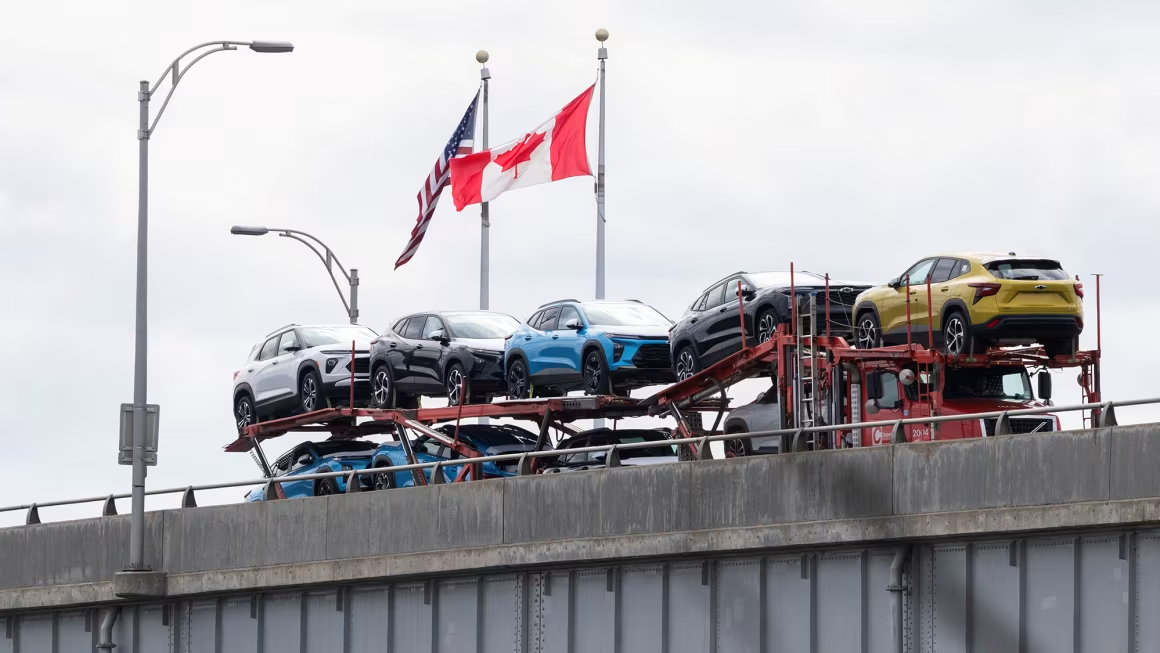


As global leaders prepare to meet in the Canadian Rockies for the annual G7 summit, attention is split between two pressing international issues: escalating global security tensions following Israel’s recent strike on Iran and the economic uncertainties surrounding U.S. trade policy. While the former has undeniable geopolitical weight, it is the latter—fueled by President Donald Trump’s looming tariff threats—that could have longer-term consequences for global markets and diplomatic alliances.

I. Trade Uncertainty Overshadows Global Security Concerns
1. Tariff Deadlines Stir Urgency Among Global Leaders
With Trump’s self-imposed July 9 deadline just weeks away, countries attending the summit are bracing for a potential surge in tariffs unless bilateral trade deals are secured in time. The possibility of renewed or even higher reciprocal tariffs—some as steep as 50%—has rattled international markets and placed urgent pressure on G7 nations to seek common ground with Washington.

2. Security Takes a Back Seat—For Now
Despite Israel’s unprecedented strike on Iran, the G7 summit is unlikely to abandon its established agenda. According to experts like Maurice Obstfeld of the Peterson Institute, security discussions may only dominate the talks if the situation escalates to a globally destabilizing level. Instead, trade is expected to dominate the private conversations and public negotiations among heads of state.
II. Global Economic Impact of Trump’s Trade Agenda
1. U.S. Tariffs Already Taking a Toll
Trump’s previous tariffs—10% on most exports to the U.S., 50% on steel and aluminum, and 25% on automobiles—have begun to show economic fallout. The United Kingdom, for example, reported a sharp contraction in its economy in April, with U.S.-bound exports falling to their lowest levels in nearly two years.

2. A Bleak Global Outlook
The World Bank recently issued a warning about the broader implications of Trump’s trade policies. Its latest report forecasts that the global economy is headed for the weakest growth decade since the 1960s, identifying U.S. tariffs as a key contributor. Projections show that both the U.S. and European economies could experience significant declines in growth due to reduced trade volumes and lingering uncertainty over future tariff actions.
III. U.S. Strategy and Summit Expectations
1. White House Signals No Shift in Approach
A senior U.S. official confirmed ahead of the summit that President Trump remains focused on his agenda to ensure “fair and reciprocal” trade agreements. While the summit will also address global security, trade remains a top priority. Treasury Secretary Scott Bessent hinted that only countries “negotiating in good faith” might be granted extensions to avoid looming tariffs.
2. Japan: A Test Case for Trump’s Trade Diplomacy
Japanese Prime Minister Shigeru Ishiba is expected to meet one-on-one with Trump during the summit. While the two leaders are reportedly making progress in trade talks, analysts such as Josh Lipsky from the Atlantic Council believe a finalized deal announcement is unlikely during the summit. Instead, the leaders may suggest they are nearing a resolution without providing Trump leverage in front of other attendees.
IV. Complex Dynamics Within the G7 and Beyond
1. European Union: The Wild Card
Of all the international discussions, those between the U.S. and the European Union remain the most unpredictable. Trump previously threatened to raise tariffs on EU exports to 50%, citing stalled negotiations. However, after a subsequent call with European Commission President Ursula von der Leyen, the threat was momentarily retracted. This back-and-forth reflects deep tensions between the two powers over trade practices and taxation policies.
2. VAT Dispute Remains a Sticking Point
One of the main points of contention is Trump’s demand that the EU eliminate its value-added tax (VAT), which he claims unfairly disadvantages U.S. exports. European officials, however, are unlikely to concede on this issue, viewing the VAT as a core element of their fiscal policy. While many EU nations may be open to modest trade concessions, changes to VAT structures remain off the table.
3. Fragmented Dialogue Within Europe
Although Trump is expected to engage directly with French President Emmanuel Macron, German Chancellor Friedrich Merz, and Italian Prime Minister Giorgia Meloni, the actual negotiation power lies with von der Leyen. This creates a complicated scenario in which discussions may occur on multiple fronts without yielding substantial progress. As Lipsky noted, this fragmented dynamic may make unified EU negotiations with the U.S. more difficult during the summit.
V. Trade Diplomacy Versus Political Theater
1. Public Statements Versus Private Agreements
As the summit unfolds, world leaders may publicly avoid finalizing any major trade announcements to sidestep appearing to concede under pressure from Washington. Behind closed doors, however, efforts to find middle ground may intensify, particularly as nations seek to protect their economies from the potential fallout of new tariffs.
2. Trump’s Leverage Strategy
Trump’s negotiation tactics—applying public pressure while offering private flexibility—are once again on full display. The strategy is designed to secure quick bilateral wins without making broader multilateral commitments, a hallmark of his administration’s approach to global diplomacy.
Conclusion
As the G7 summit approaches, trade is set to dominate discussions among world leaders, even amid rising geopolitical tensions. President Trump’s tariff threats have injected a sense of urgency into the negotiations, placing allies on edge as they seek to avoid economic penalties. While progress remains possible, especially in bilateral talks, the broader picture is one of uncertainty. The future of international trade hangs in the balance, and the outcome of this summit may well shape the next chapter of global economic policy.